The big buzz at the minute on the doomer sites is that wikileaks says the Saudis effectively say peak oil is real and that it's coming to a town near you by 2015.
The detail, however, is more interesting.
Unlike the more extremist doomer peak oil sites like dieoff which will now start ranting about the collapse of global industrial civilization circa 2015 caused by rapid depletion of oil supplies upon which *everything* depends, what the Saudis are actually saying is this:
By 2015 there will be a global production plateau which will be difficult to breach without significant investment. This plateau will last about 15 years followed by a sharp and then decelerating slow decline.
That's not too too far off of my own estimate, although I reckon the plateau will be closer to 10 years and that much of the decline will be mitigated by substitution, demand destruction as well as efficiency.
The upside to this is that it means we have something like 15-20 years to do a switchover.
Hirsch said that if we hit peak then we would have needed a crash program 10 years in advance of *depletion* in order to avoid liquid fuels shortages.
If we take the Hirsch report as reasonable rather than the out on the looney farm fringes (and I do, in spite of his failure to address certain substitutes) then we can say the following based on what the Saudis are saying:
1. We still have time to start the 10 year crash program if so needed
2. If we start now then maybe we don't need a "crash" program and merely an intensive program will be adequate
In fact, we have *already* started. Pressure to electrify the transportation system has been mounting since at least 2003. Great progress has been made on process engineering and cost reduction for both renewables and energy storage. Great progress has also been made in the transportation sector itself. We have viable (though still somewhat expensive) electric vehicles coming into production from almost all major manufacturers as well as Natural Gas alternative fueled vehicles. We also have made great leaps in our ability to extract natural gas from shale and are making increasing strides in our ability to extract from formations similar to the bakken. There are improvements to the processes for extracting usable synthetic crude from the oil sands. There has been deepwater oil discovered in quantities great enough to stave off depletion for probably another five to ten years giving us yet more breathing room. There is significant pressure to move towards fast breeder reactors to extend uranium reserves and additionally there is now a program by both India and China to attempt to utilize the much greater resource of thorium. There are efficiency programs underway also through tax breaks in many countries. In short we have options even if we have been slower on the uptake than at "emergency ramming speed".
While I do not think things are going to be easy (particularly due to the financial crisis in the western world instigated by the housing bubble and subsequent popping thereof) and I suspect we in the "developed" world are possibly going to see something like a combination of high inflation a la Britain in the early 1970s punctuated with recessions for the next two decades, I seriously doubt we are going to see fullscale collapse as foreseen by the extreme doomers.
We have the pieces in play, now it's just time to watch and see what shakes out.
I'm excited. We live in interesting times.
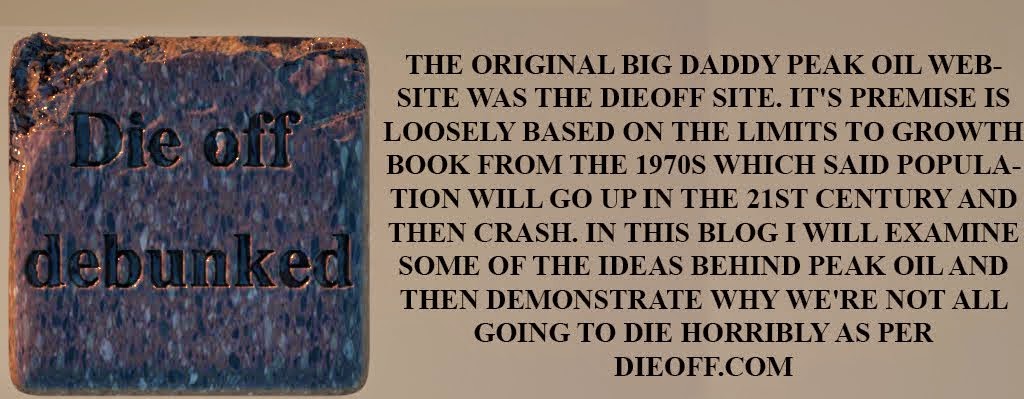
Thursday, 10 February 2011

Friday, 4 February 2011
The Economy is driven by oil
This is a very short post, fueled by Taco Bell euphoria on a friday afternoon.
So here's a thought: Many of the doomers are of the opinion that if oil production declines then GDP will decline because there is a 1:1 correlation between oil usage and the economy.
Sounds plausible right?
OK How about this for a thought experiment:
Simply buy as much oil as you can and burn it. Will that cause the economy to grow faster than anybody else?
In other words does energy inefficiency drive the economy?
I'll stick my neck out and say, NO.
I suspect that rather than the economy being driven by the amount of energy it consumes, I think there is a correlation (though NOT 1:1) between the better the economy, the more energy used all things being equal.
When you try to look at the data, however, it's hard to get a clear picture. What's definitely not true is that profligate energy consumers have the best economy in terms of GDP per head except possibly in the case of Norway.

Seems to be that Norway wastes a shit load of energy per unit of GDP and so also does Iran.
But yet, Norway is rich and Iran is poor. What gives? Maybe the *real* correlation is that if you have a ton of it, you *waste it*?
China (not a rich country in terms of GDP per head), the Netherlands and the US all use about the same amount of energy to produce a unit of GDP. China is partly self sufficient in energy and so is the USA. The Netherlands imports much of it's energy.
Germany, Japan, the UK and India all generate GDP using less energy per unit of GDP generated.
What's interesting about that is that if you look at the GDP numbers per head instead of GDP per unit of energy the ranking is different.
#1 Norway $52,238
#2 USA $47,132
#3 NL $40,777
#4 Germany $35,930
#5 UK $35,053
#6 Japan $33,828
#7 Iran $11,024
#8 China $7,518
#9 India $3,290
So what do the rankings show: The highest (out of this small section) is Norway, which has a large oil production per capita. The only other large oil exporter in the list is Iran who is down at the bottom end and nowhere near the rich countries. The world's pre-eminent manufacturing rising star is China, who is no more efficient nor more inefficient at producing GDP using energy than the United States or the Netherlands.
The interesting question is this: where are the countries placed who have no oil resources of their own?
Japan, the Netherlands and Germany virtually have to import all of their oil yet they are all firmly in the rich country grouping. What gives?
Perhaps the relationship of GDP to energy usage for a country is more complicated than the doomers make out hmmm?
Monday, 31 January 2011
What *is* the present day grid parity cost of Solar Panels in the US?
Grid parity always seems to be around the corner. It's already there in sunnier parts of Southern Europe and South Africa. But what about the U.S.? Is there anywhere it's already reached grid parity?
As it turns out, the answer is yes. In Dallas, Texas, it's possible today to purchase a solar panel system which over the course of 40 years (the active service life of installed solar panels, with data reaching back to the 1970s), the per kilowatt cost of solar panels installed today is at par with electricity bought from the spot market.

.....
We're not there yet for the rest of the country for varying reasons, but I suspect we're pretty close.
Now we may ask a particularly relevant question:
What does this mean?
Well let's take a couple of scenarios:
Scenario 1:
Let's say that fossil fuels are doomed to decline over the next twenty years or so.
Scenario 2:
Technology will be developed to unlock the vast resource of unconventional fossil fuels.
In the case of Scenario #1, the price of fossil fuels will start on an upward slope and since it will be far cheaper to generate power from solar panels then that's exactly what we'll get.
The economy will probably grow slower initially since although the electrical economy is more efficient than the fossil fuels powered one, renewables are starting from further back and so will take some time to build up a head of steam.
In Scenario #2 we will get more of the same (i.e. greater quantities of fossil fuels than before). The economy will continue to grow based on the old paradigm, but technology will continue to advance and the transition to a sustainable renewables powered electrical economy will just take longer than in scenario #1.
In either case, however, we're not going to be seeing any kind of dieoff graph. Instead we're going to continue to see the global economy grow.
Wide Spectrum Solar Panels coming to a theater near you
So I've talked a bit about solar panels in the past and I'm a big fan of them, not least because one of America's most successful inventors of all time predicated they would ne the ultimate in energy production.
To my mind, the piece we're missing is *inexpensive* and *easy to manufacture in bulk* are the key pieces missing. Looks like we might be nearly there.

Recently, however, the US department of Energy's Berkeley lab demonstrated a solar cell which can be made cheaply and easily using a well known and commonly used manufacturing process from the semi-conductor industry.
In other words we're more or less talking about solar cells being printed as if they are silicon chips.
On a related note, even without this technology, the naysayers (such as Exxon Mobil) are saying that in their estimation, solar will continue to grow at 10% annually till 2030.

Back In reality, however, the installed base of solar has been doubling every two years, not every seven. At that rate of growth we will see 10% of electricity supplied by solar by 2022 and 20% by 2024. Along with wind, hydro and nuclear we should be easily over 50% by the projected end date, with the balance made up by coal, natural gas and greater efficiency.
Given the greater efficiency of electrically powered transportation - 4x - (by far the greatest consumer of oil), it is not a stretch of the imagination to take a guess and say that even if we maintain total energy production at today's rate but change the ratio from 80% fossil fuels and 20% renewables/nuclear to 50% fossil fuels and 50% renewables/nuclear then we in fact have two times the total utility from a static energy supply. Also it's worth pointing out that once we see grid parity (i.e. the cost of solar energy produced by solar is the same as that produced by other forms of electricity) we should see solar power explode in terms of installations. There is evidence to suggest that we're already there in some parts of the world and will be there in North America by 2015 and China earlier still.
If we assume (and this is incorrect - but let's play their game to be ultra-conservative) that there's a 1:1 correlation between energy utility and GDP growth then we're talking about doubling the size of the global economy by 2030. I make that to be an annual average growth rate of 3.7% even while standing still in terms of energy output. Not too shabby.
Are we doomed yet?
Now that the new year is upon us I thought it would be appropriate to check out the predictions from the other side. So I have included the graph from our good buddies at dieoff.org the antithesis of this site.
This is the graph from dieoff.org with the *very specific* timelines in it as to exactly *when* we are doomed. Does anyone else think it's very conspicuously coincidental that the "collapse" will be coming in 2012? Only one year till Dooooooooooooooooooom!!!!

This is the graph from dieoff.org with the *very specific* timelines in it as to exactly *when* we are doomed. Does anyone else think it's very conspicuously coincidental that the "collapse" will be coming in 2012? Only one year till Dooooooooooooooooooom!!!!

Tuesday, 25 January 2011
Death by Jevons Paradox
One of the most quoted myths among doomers is that it's impossible to cut back on Energy Usage without collapsing the economy or that any attempt to cut back in one area of oil usage will ultimately lead to more consumption in another area or that substitutes are impossible.
I won't argue in this post about efficiency programs such as those proposed by the Rocky Mountain Institute, but here instead I will focus on one application of "Jevons Paradox".
Jevon was a late industrial revolution thinker who suggested that Britain would eventually collapse because of it's dependence on coal. His reckoning was that consumption would be reduced in one area of demand but would balloon in another once overall demand was reduced temporarily.
The reasoning was that coal was so useful combined with no available substitutes that no attempt could be made to reduce demand. It's a variation of a single variable commodity in a commons accessed by multiple players with no incentive to limit their consumption, known as "the tragedy of the commons". This theory along with Jevons Paradox has several flaws, not least of which is specialization of trade in secondary commodities in exchange for the commodity produced from the commons.

This is the exact same fallacy that drives dieoff theory and most of the peak oil doomer arguments. There is no substitute to oil they say and demand can not be reduced by greater efficiency and thus once oil supplies peak and start to decline, death of industrial civilization is guaranteed.
Over time, it has become apparent that this is simply not true and that not only can efficiency and demand destruction reduce overall demand, but also there are substitutes to oil.
But wait, say the doomers, there is something called the export-land model.
This theory is also deceiving. What it basically says is a continuation of the original fallacy (there is no substitute and no possible efficiency gains) but that in exporting countries, the demand will continue to rise ad-infinitum until the point at which peak production is reached.
At that point, production will be declining but demand in the exporting country will be rising along with everybody else in the importing countries. Since the exporting countries demand rise will make less available for export, the importing countries will see a greater hit than the overrall decline rate.
Although the data bears this out (especially in Saudi Arabia) to a large extent for several (though not all) conventional crude exporters, there is no 100% consensus on the data across the board.
In reality we have at least one clear example where an exporting country limits its own consumption in order to export as much as possible: Norway.
There are other outliers, though the data suggest *some* basis to the export-land model.
In particular, the export-land people point to Saudi Arabia and Iran as both increasing consumption ahead of any declines and potentially even past decline.
Now taking any desire to build Nuclear Weapons out of the picture, it could be argued that the Iranians are going counter to Export-Land by seeking to build nuclear power stations rather than continue to burn oil in their power stations. Across the globe, import-land countries have substituted out oil fired generating plants for alternatives such as natural gas fired, nuclear and renewables.
Also, according to export-land it should be impossible for heavy importers such as the United States to decrease internal demand for oil never mind start exporting oil or oil substitutes. And yet, even when the United States has to spend a proportion of it's GDP to defend oil supplies militarily AND import two thirds of its oil, it is *still* exporting oil substitutes such as liquid natural gas. It should by all rights be converting every last cubic inch of natural gas into oil according to export-land, shouldn't it?
But let's ignore that and return to the star of export-land itself: Saudi Arabia.
Just recently, Saudi Oil Minister Ali al-Naimi stated that he sees "no difference between oil reserves and alternative energy" and that Saudi Arabia is now taking steps to utilize other forms of energy such as "their massive resource of solar energy combined with nuclear energy".
He notes that current consumption of oil within the Kingdom is around 3 million barrels per day and projects that consumption could rise to 8 million barrels per day around 2030. Since the volume of exports is 8 million barrels per day, even with no peak and decline in production, by 2030 there will be no oil available for export from Saudi Arabia.
Not even considering the effect on importing nations of losing Saudi Arabia, the impact on Saudi Arabia itself would be dramatic, since the economy is so skewed towards oil production and so lacking in other areas.
al-Naimi goes on to say, "a continued rise in local consumption will ultimately limit the export capacity of the Kingdom and it's DEVELOPMENT (emphasis mine). We must therefore
transform a country dependent SOLELY on oil to one using different sources of energy - nuclear and renewables,in order to conserve oil and keep it for export."
Thus the export-land paradigm is being intentionally broken even by it's superstar Saudi Arabia.
Further, al-Naimi goes on to say, "We are consulting with everybody who has technology in these areas - Koreans, British, Americans, Japanese and French".
In other words, the one with the most to gain from an increase in oil prices recognizes the solution both to Jevon's paradox and to the tragedy of the commons: Trade and Substitution. Even as oil prices go up and up, Saudi Plans to spread the wealth and limit the damage from rising oil prices precisely to those economies who would be most impacted by oil price rises and decreasing exports (assuming no substitutes existed).
Human ingenuity, greed, self-preservation and the profit motive win again.
Nice try doomers, but still no cigar.
Wednesday, 19 January 2011
Global Extinction Event
An anonymous poster asked about possible human extinction caused by acidification of the oceans. I believe I answered him reasonably well enough why I think that ocean acidification is unlikely to cause an extinction.
That said I did some reading about "anoxic events" and extinction events etc and the big one appears to be the K-T exinction where more than 90% of the world's species went extinct over a period of a couple million years.
Here's what's interesting:
There was at least one and probably many comet impacts during this period combined with a long (half a million years) period of volcanic eruptions.
What's interesting about this is that the food chain collapsed.
Well if we ask what that means it's the following: photosynthetic plants perished in great numbers during this period.
Sounds like "the road"!!!
If we ask ourselves what could cause this then we loop back and take a look at what actually happened then maybe we can draw some conclusions.
So first of all: what would cause photosynthesis to decline?
Well the most obvious answer is if the amount of sunlight went down.
That obviously didn't happen, since the Sun isn't very variable, so what else could have caused it?
Possibly massive plagues on plants or something blocking the ability of plants to use the available sunlight.
We don't have any evidence of any plagues on plants but comet impacts and volcanoes both throw huge amounts of dust into the atmosphere. We have evidence for both comet impacts and a long (half a million years) period of intense volcanic activity.

So maybe during this period the available sunlight was severely blocked by dust?

If that happened again I'd have no problem believing in "the road" type scenarios being in our future, but the situation we have isn't analagous. In fact it's more analagous to suddenly turning up the thermostat with the same amount of sunlight getting in.
The evidence suggests that plants do better with more heat so we're unlikely to see a collapse in photosynthesis on land. In the oceans we could see some issues for deepwater organisms and carbonate shelled organisms due to acidification (yet there's also evidence for foraminfera during super greenhouse events so clearly they don't ALL die out).
On balance it's hard to say what would happen without all the dust being injected into the atmosphere concurrently with carbon dioxide as happened during the K-T extinction event. I suspect there would be winners and there would be losers.
Animals on land did better during the K-T event. Although many died (primarily herbivorous animals), omnivores and detritus eaters did well.
I also suspect (call it anthropocentric arrogance if you like) that we would survive even a dust+carbon dioxide catastrophe given that we are omnivores and very very inventive, but carbon dioxide and global warming alone are not going to cut it to wipe us out.
Civilization itself is also pretty resilient as long as there is enough sunlight to grow crops. Some extreme doomers have said that the human species has never had to pass through a climate as warm as the super greenhouse climate of the cretaceous. I beg to differ. Saudi Arabia regularly reaches temperatures of 50C which is ridiculously hot, yet civilization continues there quite happily, though they depend heavily on technology and also on trade, similar to Las Vegas. Given that Canada, Siberia and Greenland would become productive farmland at the expense of other regions which warmed up too much to continue to be as productive agriculturally as they are now*, the losing regions would have to depend on trade, but technology would allow them to continue to survive. Las Vegas is damn hot for example and it survives on trade, thought the ecologists would say it's "unsustainable".
*Astute readers may note the apparent contradiction that plants like more heat with the fact that beyond a certain point, raised temperatures start to cause declines in agricultural production. The reason for this is that as it gets hotter, there is more and more evaporation and while the total quantity of water remains the same and plants are able to continue to photosynthesize, the plants aren't able to access the water because it's in the air instead of the soil. The solution to that particular problem is rainforests which are able to hold on to and regulate the water cycle more efficiently than we can in hotter regions. What that implies is the shift of agriculture to higher latitudes. Luckily, however we have tons of land up north.
Returning to the question of whether human civilization is robust at higher temperatures versus the charge by the ecologists that the human *species* has never dealt with such high temperatures before even though we have proof right now that we have (the cities in hot regions):
If what the ecologists and doomers are really saying is that human beings unaided could not survive such extreme temperatures well duh. I've been arguing all along that our current population depends on technology and technology will be required to maintain our current population.
Additional greenhouse gases and increased temperatures will do nothing to affect our ability to continue to maintain our technological base. On the contrary, the greenhouse gas doomers are the ones demanding the shutdown of our economy and the collapse of our technological base.
In fact the cut back solution is equivalent of pulling the rug out from under civilization if you examine the evidence of what actually DOES cause extinctions.
Shut down the economy and we're fucked.
Those who support that concept in order to reduce greenhouse gases are insane misanthropists nothing more nothing less.
Subscribe to:
Posts (Atom)