So I've talked a bit about solar panels in the past and I'm a big fan of them, not least because one of America's most successful inventors of all time predicated they would ne the ultimate in energy production.
To my mind, the piece we're missing is *inexpensive* and *easy to manufacture in bulk* are the key pieces missing. Looks like we might be nearly there.
Recently, however, the US department of Energy's Berkeley lab demonstrated a solar cell which can be made cheaply and easily using a well known and commonly used manufacturing process from the semi-conductor industry.
In other words we're more or less talking about solar cells being printed as if they are silicon chips.
On a related note, even without this technology, the naysayers (such as Exxon Mobil) are saying that in their estimation, solar will continue to grow at 10% annually till 2030.
Back In reality, however, the installed base of solar has been doubling every two years, not every seven. At that rate of growth we will see 10% of electricity supplied by solar by 2022 and 20% by 2024. Along with wind, hydro and nuclear we should be easily over 50% by the projected end date, with the balance made up by coal, natural gas and greater efficiency.
Given the greater efficiency of electrically powered transportation - 4x - (by far the greatest consumer of oil), it is not a stretch of the imagination to take a guess and say that even if we maintain total energy production at today's rate but change the ratio from 80% fossil fuels and 20% renewables/nuclear to 50% fossil fuels and 50% renewables/nuclear then we in fact have two times the total utility from a static energy supply. Also it's worth pointing out that once we see grid parity (i.e. the cost of solar energy produced by solar is the same as that produced by other forms of electricity) we should see solar power explode in terms of installations. There is evidence to suggest that we're already there in some parts of the world and will be there in North America by 2015 and China earlier still.
If we assume (and this is incorrect - but let's play their game to be ultra-conservative) that there's a 1:1 correlation between energy utility and GDP growth then we're talking about doubling the size of the global economy by 2030. I make that to be an annual average growth rate of 3.7% even while standing still in terms of energy output. Not too shabby.
Showing posts with label die off. Show all posts
Monday, 31 January 2011
Are we doomed yet?
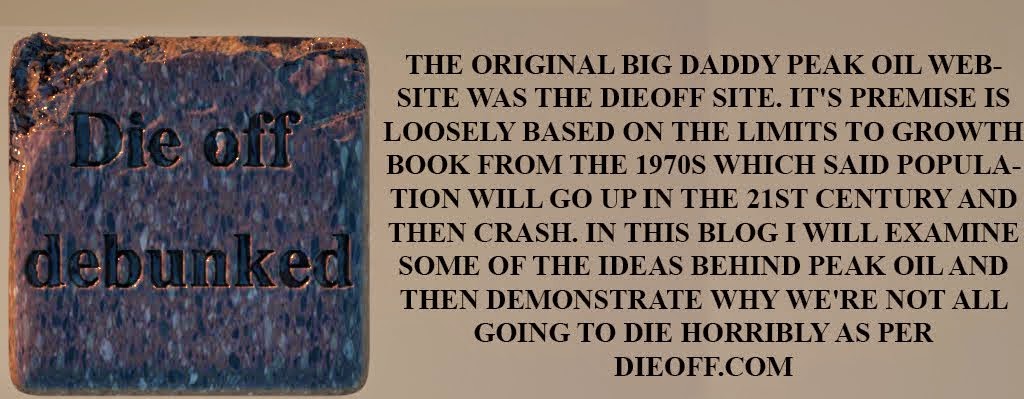
Now that the new year is upon us I thought it would be appropriate to check out the predictions from the other side. So I have included the graph from our good buddies at dieoff.org the antithesis of this site.
This is the graph from dieoff.org with the *very specific* timelines in it as to exactly *when* we are doomed. Does anyone else think it's very conspicuously coincidental that the "collapse" will be coming in 2012? Only one year till Dooooooooooooooooooom!!!!
Labels:
die off,
Die off debunked,
Dieoff debunked,
Peak Oil Debunked
Monday, 16 August 2010
Revisiting Energy Storage for Wind
Some non-believers in the techo-luddite camp believe that wind or other renewables cannot ever replace fossil fuel based power for the simple reason that the wind and/or sun blows/shines at inconvenient times vis a vis power demand.
Ignoring completely that electric vehicles will most likely be run off of batteries which are *stored power* and all by themselves will solve the intermittency problem, there is an already existing and *operational* technology that will also solve the problem.
Back in the 80s a man named Michael Nakhamkin designed the United State's first compressed air storage plant in McIntosh Alabama.
This plant was built for a small utility called Alabama Electric Cooperative.
The problem AEC had was that the power demand did not match the supply. (Sound familiar?)
What they had was that the supply vastly overwhelmed the demand at night. They were running a coal plant at night which provided way more electricity that could be used. Running the coal plant at lower capacity wasn't workable because coal plants are more efficient at 100% capacity and running it down created excess pollution. Then during the day, the plant couldn't provide enough power to meet demand and so AEC had to buy power from other companies at the vastly inflated marginal price. So what to do?
The solution was to create some sort of storage facility.
Luckily such a storage facility already existed in Huntorf, Germany and was fairly straightforward to copy for US implementation. It was a salt dome which was partly dissolved and resealed leaving a giant air compression chamber.
During off-peak times, electricity runs a compressor which pumps the air down into the cavern. Then, when energy is needed, the air is released from the reserve to power a fairly standard turbine, with a little help from natural gas. The system has worked for more than 25 years.
In 1991, when the plant went online, there were high hopes that the technology might catch on among utilities.
‘We expect the CAES plant technology pioneered in Alabama to lead to widespread application in this country,” said Robert Schainker, the manager of the Electric Power Research Institute’s Energy Storage Program in a press release announcing the plant’s completion. ‘Three fourths of the United States has geology suitable for underground air storage. At present, more than a dozen utilities are evaluating sites for CAES application.”
But with low fossil fuel prices and little intermittent renewable energy on the grid, there wasn’t much incentive for utilities to build the plants. The plant saved money for the Alabama Electric Cooperative, but it wasn’t “critical savings” as Nakhamkin put it.
“Rich people don’t talk about how to save five or 10 dollars,” he said.
So the salient points here are the following:
• Even at 1990s prices of electricty, salt dome compressed air storage was cost-competitive (and even saved some (small) amount of money.
• We don't *need* storage for the grid until 20% or greater as the European experience has shown
• 75% of the United States already has the necessary geology to do this.
• It wasn't done because the investment required to save a small amount of money was too great.
So it seems that there is no *practical* nor *technical* reason that it wasn't done. It was that electricity was TOO CHEAP to care about small savings.
So if as the doomers say, electricity prices have nowhere to go but up, then it will also become financially sensible to invest in this kind of storage technology which means there is no reasonable limit on how far we can scale up wind or solar.
And that's entirely ignoring other solutions such as the millions of electric car batteries soon coming online or the ability to ramp up storage into e.g. large refigeration facilities and let them run down overnight etc etc
Seems that the prognostications of doom based on forever rising electricity prices are, shall we say, somewhat of a stretch, hmmmm?
Subscribe to:
Posts (Atom)