The Financial System will Collapse because of Peak Oil.
It's often heard on peak oil doomer sites that Peak Oil will lead to the collapse of our financial system because our system depends on growth and peak oil will cause growth to stop and thus since our financial system owners know this, once peak oil is identified, all the money will be pulled out and things collapse.
Let's take a look at these one by one.
1. Our Financial System Depends on Growth
This is really a two part argument. The first is about interest and the second is about growth in the economy. In the first case the argument is that the financial system depend on interest and that it needs interest to continually be paid back otherwise the scheme will collapse.
OK Let's look at that.
What is interest?
It's a percentage of the principal of a loan which will be paid back in addition to the original principal.
OK with me so far? It's naively possible to say that if the lender doesn't get paid the interest the system will collapse, right? And further, that OIL is required to generate the income to pay it back. Well, interestingly (no pun intended) interest doesn't always get paid back, and also interest existed long before we had an oil based economy.
The money to pay back interest is generated from income which is not spent now and comes from labour OR capital. Note that I said labour OR capital, not capital only.
Is the financial system based on interest?
Certainly part of it is, but it's naïve to say that all of it is.
The system in fact is based on RISK. The higher the risk, the greater the reward. Sometimes this reward comes in the form of interest (as in money lending). Sometimes it comes in the form of asset appreciation due to speculation, yet other times it comes from "buy low, sell high".
The argument that interest will disappear with peak oil must be extended fully to mean that no profit can be made post peak oil. This is clearly false.
In fact, even the interest part of the financial system is based on risk. The riskier the debtor, the higher the interest the debtor must pay in exchange for the loan. In other words, the interest is a reward for taking the risk, not a guarantee of return. Currently as it stands, loans are not repaid all the time. Some of them are collected and some are not. The bankruptcy system is in place to make sure that an honest but insolvent debtor can escape his/her debts and the bad debt is written off via the taxation system.
The best the peak oilers can argue is that an oilshock induced recession would increase the number of bad debts (as recessions always do) and thus the amount of credit available to the system would reduce (called "tightening lending"). This is hardly a disaster and is the normal situation. Post recession, any banks would be better placed to predict who would be a good creditor and who wouldn't. So the interest part would conceivably contract but not disappear.
Is the entire system based on interest? No it is not.
Parts of it (the commodities market, the futures market and the stock market) are based on asset appreciation. Bidders for the various instruments bid on their perceived value of an instrument whether it is undervalued (if they're going long) or whether it is overvalued (if they're going short). This type of instrument (in the stock market for example) is based on the premise that a profitable company will be worth more in the long run and thus pay higher dividends (share of profit) in the future, or not as the case may be. Since stock markets existed in the seventeenth century (pre industrial revolution) and commodities markets for much longer than that, it's hard to argue that they depend on oil.
The second case is an interesting one because it using the word growth to mean many things. In the context of the peak oil doomer argument, growth is generally assumed to mean "growth in resource usage" because of the assertion that economic growth needs energy growth and that the only "real" kind of growth is growth that creates more "stuff". The doomer argument is that you cannot have unlimited growth in a finite world and our system (based on infinite growth) is therefore unstable and will ultimately collapse.
Well, if you look at the question of "growth", with regards to the financial system, what you're really talking about is the growth of savings. Is it possible that savings can grow without an oil based economy? Why yes it is. All someone has to do to grow their savings is to spend less than they earn. Unless the doomers are going to argue that peak oil means everybody suddenly has to spend every penny they ever earn from now on, then the argument that growth of savings will stop is nonsensical. Clearly we can grow savings.
Can we grow the economy? Yes we can. All we need to do is have people spend more and more money. How is this possible even today if people don't have infinite money? It isn't possible long term even today. Growth today is based on fractional reserve banking which multiplies the money in deposit accounts by the "money multiplier". This allows the economy to grow beyond it's natural rate limited by the growth of savings.
Now the more astute among you will have noticed an anomaly when we talk about growth.
It's this: growth cannot possibly continue forever unless either income rises forever or else the money multiplier is infinite.
So we have stumbled on a fundamental truth. Our current system isn't based on growth.
The horror!
So what IS it based on?
Cycles.
This is evident in the commodities markets where the cycles are visible based on growing seasons. EVERY other market is exactly the same, except the cycles are longer.
Clearly since summer always follows winter, a system based on cycles will always seed, grow, boom and bust only to do the same again next time. The key point is that one industry is replaced by another and "growth" is in the new industry which replaces the old.
What we are witnessing with peak oil is the end of the boom phase of the oil industry. Concurrently with this we are in the very early stages of the "seed" phase of the industries that will replace oil.
Our system is based around this fundamental fact.
Now the doomers could say "but our economy has been growing steadily concurrently along with oil".
I would argue that what they are seeing is correlation, not causation.
In an apples to apples comparison, a large populous country with similar laws and infrastructure to a smaller country in terms of population with similar laws will have a smaller economy.
There is thus a reasonable argument behind the proposition that just maybe, the world economy is so large because the population is so large and that the larger the population, the more energy is used. The causative factors are exactly backwards from what the doomer crowd would have us believe.
The second part will follow later.
Tuesday, 6 October 2009

Tuesday, 2 June 2009
Average Oil Production per Capita Declining since 1979
Over at dieoff.org, our goods friends are making much of the fact that up till 1979 there was a gradual increase in per capita energy production and then a decline for the first time in history.
In fact, this is not the case.
The first time in history there was a decline in per capita energy production was in the early middle ages just prior to the great plague. Europe's forests had been depleted and the cost of wood had soared. This was eventually overcome by the industrial revolution and the use of coal as a replacement for wood. During the transition period, however, there was some suffering and the global economy went through hard times.
It's likely that this time the coming decline in oil will be met by alternatives in both energy sources and substitutes at the end-use stage such as in electric transportation.
Returning to the point about declining world per capita from about 1979 (according to dieoff.org), the facts check out. On a global basis, there has in fact been a global decline in per capita energy production.
Taken at face value that sounds like it might be an "oh shit what do we do now moment".
I'm a natural cynic, however, so first I'd like to ask a couple of questions before I hope on over to LATOC to buy some ammo and some MREs and hunker down for the zombie apocalypse
First:
While the global average has gone down, is the distribution of the decline uniform or is it uneven?
Second:
Even if it turns out that the distribution of the decline is uniform, does that mean due to diminishing energy production per capita, we now have less stuff per capita than the 1980s?
Well a quick and easy search from our friend google shows us that in answer to the first question the decline is not in fact uniform. Most of the decline is due to a flattening out of the world demand profile. We have added two billion people in the third world while the rich world (North America, Europe, Japan etc) have increased barely. The population of the United States has increased about fifty million while the population of Europe and Japan have declined slightly.
It's interesting to note that the rich world countries have dropped their per capita oil usage by around 10% on average. So I guess we must be doomed, huh?
The biggest energy hogs have been the OPEC countries and China, of which both regions have more than doubled their average per capita energy consumption.
So I guess they must be less doomed than us, right?
OK so how about the second question?
If we in the rich world and they in the third world are using less energy per capita does that mean we have less stuff because of less energy. i.e. less food, less big screen TVs, less cars, etc etc
Well as it happens the data are conflicting.
The two billion people added to the third world do in fact have less stuff. They have less food than they had before and their position is worse. Maybe they're overpopulated.
In the rich world, however, things are different. Though the per capita energy usage has declined on average (very slightly in the US, close to 10% in Europe and a little more in Japan), has the average amount of stuff gone up per capita in those three regions since 1979?
Why yes it has. All three regions are suffering from an obesity epidemic with the average per capita calory intake going from 2500 in the 1970s to 3500 today.
Likewise, the GDP of all three regions has increased massively. More than doubled in fact.
But how can this be?
The answer is efficiency.
In all three regions, the amount of energy used per unit of GDP has declined substantially. The Japanese are the most efficient, the Europeans next and the North Americans last.
What does that mean?
It means that energy belts can be tightened and the economy can grow even while the net energy per capita is declining. This is particularly true in North America where we still drive enormous vehicles with ridiculously low miles per gallon for fuel consumption.
In fact, this is not the case.
The first time in history there was a decline in per capita energy production was in the early middle ages just prior to the great plague. Europe's forests had been depleted and the cost of wood had soared. This was eventually overcome by the industrial revolution and the use of coal as a replacement for wood. During the transition period, however, there was some suffering and the global economy went through hard times.
It's likely that this time the coming decline in oil will be met by alternatives in both energy sources and substitutes at the end-use stage such as in electric transportation.
Returning to the point about declining world per capita from about 1979 (according to dieoff.org), the facts check out. On a global basis, there has in fact been a global decline in per capita energy production.
Taken at face value that sounds like it might be an "oh shit what do we do now moment".
I'm a natural cynic, however, so first I'd like to ask a couple of questions before I hope on over to LATOC to buy some ammo and some MREs and hunker down for the zombie apocalypse
First:
While the global average has gone down, is the distribution of the decline uniform or is it uneven?
Second:
Even if it turns out that the distribution of the decline is uniform, does that mean due to diminishing energy production per capita, we now have less stuff per capita than the 1980s?
Well a quick and easy search from our friend google shows us that in answer to the first question the decline is not in fact uniform. Most of the decline is due to a flattening out of the world demand profile. We have added two billion people in the third world while the rich world (North America, Europe, Japan etc) have increased barely. The population of the United States has increased about fifty million while the population of Europe and Japan have declined slightly.
It's interesting to note that the rich world countries have dropped their per capita oil usage by around 10% on average. So I guess we must be doomed, huh?
The biggest energy hogs have been the OPEC countries and China, of which both regions have more than doubled their average per capita energy consumption.
So I guess they must be less doomed than us, right?
OK so how about the second question?
If we in the rich world and they in the third world are using less energy per capita does that mean we have less stuff because of less energy. i.e. less food, less big screen TVs, less cars, etc etc
Well as it happens the data are conflicting.
The two billion people added to the third world do in fact have less stuff. They have less food than they had before and their position is worse. Maybe they're overpopulated.
In the rich world, however, things are different. Though the per capita energy usage has declined on average (very slightly in the US, close to 10% in Europe and a little more in Japan), has the average amount of stuff gone up per capita in those three regions since 1979?
Why yes it has. All three regions are suffering from an obesity epidemic with the average per capita calory intake going from 2500 in the 1970s to 3500 today.
Likewise, the GDP of all three regions has increased massively. More than doubled in fact.
But how can this be?
The answer is efficiency.
In all three regions, the amount of energy used per unit of GDP has declined substantially. The Japanese are the most efficient, the Europeans next and the North Americans last.
What does that mean?
It means that energy belts can be tightened and the economy can grow even while the net energy per capita is declining. This is particularly true in North America where we still drive enormous vehicles with ridiculously low miles per gallon for fuel consumption.
Monday, 1 June 2009
Hirsh Report Liquid Fuels Shortage Debunked
More on the "no substitutes" bit.
So let's imagine for a second that oil production starts falling off a cliff next Wednesday.
The typical gleeful response of the dieoff crowd would be: "there are no substitutes to oil" and thus the transportation network will collapse and then the lights will go off etc etc and WE WILL ALL DIE.
The Hirsch Report, which is a little more reasonable than the sackcloth and ashes crowd over at dieoff.org, says "if we do not mitigate there will be a liquid fuels shortage especially in transportation after we peak".
Unfortunately for this premise, however, is one little fact: We have an ENORMOUS GLUT of shale gas and gas is a good substitute for oil, especially in transportation.
Estimates are that shale gas reserves are up to five times the "conventional" reserve which did in fact peak and start declining in North America about 8 years ago and now Europe.
Now what about those pesky substitutes? Can we run our transportation fleet off of natural gas? Is there infrastructure in place to do so? Will all our delivery vehicles stop running because we're "out of oil" since the party is over?
Well seems to me that the local gas utility runs their maintenance fleet of vans and trucks off of Nat Gas. Also seems to me that every second gas station is ALREADY SELLING Nat Gas.
I've also seen a ton of taxi cabs running off of natural gas.
So how much does it cost, exactly, to convert your car to run on natural gas?
All of about four grand.
Now I personally like electric transportation and conservation as the long term solution to peak oil induced transportation bottlenecks, but you can hardly argue with a massive glut of natural gas and such low conversion costs.
Oh yeah. There's also gas to liquids. Such as gas to aviation fuel. I wonder if now is a good time to buy airline stocks.
Now where does that leave us?
Well if we try to peak into the crystal ball of "life after depletion" it seems that we have at least three sustitutes with which to mitigate so while the steepness of the conventional curve cannot be flattened, we can substitute out the end-uses.
Conservation "take the damn bus".
Electrification "take the damn electric bus" and "look at me go fast in my new Tesla".
Conversions to run your car on nat gas "Oh look, it's only a buck twenty for a gallon of nat gas".
Gas-To-Liquids "Kunstler says we can't run the interstate truck fleet without diesel. Maybe not, but there's no reason we can't run our interstate fleet on gasoline trucks converted to nat-gas".
So yet another dieoff myth debunked. Not only do we have substitutes, but they are relatively cheap compared to the other substitutes like electric vehicles which currently carry a price premium.
Doom? Maybe, but if so, not yet and not because of peak oil.
For more on the natural gas glut see http://ghawarguzzler.blogspot.com/
So let's imagine for a second that oil production starts falling off a cliff next Wednesday.
The typical gleeful response of the dieoff crowd would be: "there are no substitutes to oil" and thus the transportation network will collapse and then the lights will go off etc etc and WE WILL ALL DIE.
The Hirsch Report, which is a little more reasonable than the sackcloth and ashes crowd over at dieoff.org, says "if we do not mitigate there will be a liquid fuels shortage especially in transportation after we peak".
Unfortunately for this premise, however, is one little fact: We have an ENORMOUS GLUT of shale gas and gas is a good substitute for oil, especially in transportation.
Estimates are that shale gas reserves are up to five times the "conventional" reserve which did in fact peak and start declining in North America about 8 years ago and now Europe.
Now what about those pesky substitutes? Can we run our transportation fleet off of natural gas? Is there infrastructure in place to do so? Will all our delivery vehicles stop running because we're "out of oil" since the party is over?
Well seems to me that the local gas utility runs their maintenance fleet of vans and trucks off of Nat Gas. Also seems to me that every second gas station is ALREADY SELLING Nat Gas.
I've also seen a ton of taxi cabs running off of natural gas.
So how much does it cost, exactly, to convert your car to run on natural gas?
All of about four grand.
Now I personally like electric transportation and conservation as the long term solution to peak oil induced transportation bottlenecks, but you can hardly argue with a massive glut of natural gas and such low conversion costs.
Oh yeah. There's also gas to liquids. Such as gas to aviation fuel. I wonder if now is a good time to buy airline stocks.
Now where does that leave us?
Well if we try to peak into the crystal ball of "life after depletion" it seems that we have at least three sustitutes with which to mitigate so while the steepness of the conventional curve cannot be flattened, we can substitute out the end-uses.
Conservation "take the damn bus".
Electrification "take the damn electric bus" and "look at me go fast in my new Tesla".
Conversions to run your car on nat gas "Oh look, it's only a buck twenty for a gallon of nat gas".
Gas-To-Liquids "Kunstler says we can't run the interstate truck fleet without diesel. Maybe not, but there's no reason we can't run our interstate fleet on gasoline trucks converted to nat-gas".
So yet another dieoff myth debunked. Not only do we have substitutes, but they are relatively cheap compared to the other substitutes like electric vehicles which currently carry a price premium.
Doom? Maybe, but if so, not yet and not because of peak oil.
For more on the natural gas glut see http://ghawarguzzler.blogspot.com/
Friday, 22 May 2009
Mineral Resource Depletion
On some of the more malthusian peak oil sites there is the theme that not only are we facing peak oil, but also peak fertilizer, peak gas, peak coal etc, along with peak mineral extraction. Others rant about the "limits to growth". I started wondering exactly how much resource we really have extracted.
One way of looking at this would be to ask some questions.
For example: Is the Earths crust uniform or are there nodes where minerals or useful resources are concentrated?
In fact, history shows that we have concentrations of minerals and they are mined or extracted by wells such as is the case with oil or gas.
Which gets me to thinking? Is it reasonable to assume that even if we use up a lot of the oil and gas which cannot form at lower depths, is this true for other resources?
The answer to that is no. Other minerals and especially metals (such as for example, lithium or manganese) do not require special temperature and pressure gradients to exist. They will be found all through the Earth's crust.
So: How deep is the deepest mine we have yet drilled?
Our friend google returns the answer of 3800 meters.
That, I should point out is not the average depth of mines, it is the DEEPEST YET DUG.
So what is the depth of the Earth's crust?
40,000 meters.
Seems we haven't even reached 10% of the Earths "limits to growth".
It's quite possible that you can't have infinite growth on a finite world, but we're nowhere near the limits.
One way of looking at this would be to ask some questions.
For example: Is the Earths crust uniform or are there nodes where minerals or useful resources are concentrated?
In fact, history shows that we have concentrations of minerals and they are mined or extracted by wells such as is the case with oil or gas.
Which gets me to thinking? Is it reasonable to assume that even if we use up a lot of the oil and gas which cannot form at lower depths, is this true for other resources?
The answer to that is no. Other minerals and especially metals (such as for example, lithium or manganese) do not require special temperature and pressure gradients to exist. They will be found all through the Earth's crust.
So: How deep is the deepest mine we have yet drilled?
Our friend google returns the answer of 3800 meters.
That, I should point out is not the average depth of mines, it is the DEEPEST YET DUG.
So what is the depth of the Earth's crust?
40,000 meters.
Seems we haven't even reached 10% of the Earths "limits to growth".
It's quite possible that you can't have infinite growth on a finite world, but we're nowhere near the limits.
Batteries will save us
The premise is this: dieoff says technology is not a substitute for oil.
In this post I will argue not only that technology is in fact a substitute for oil but that we've been using technological substitutes for an age and a day.

In the middle ages, we reached "peak wood" where Europe's population had soared due to the invention of better farming methods, and correspondingly, the hugely increased demand for wood depleted Europes forest. Subsequently, there was the great plague and replacement of wood with coal, but was there anything else notable that happened?

Why yes there was. Since the population collapsed, there weren't so many laborers available to for example, mill flour. So what happened?
The response was technology. More specifically wind.

Windmills and river mills were invented and this renewable power freed up labor to do other things, like go off and invent steam engines.

Other times technology has saved us are the taming of fire (we could cook tough plants previously unable to be eaten raw), the invention of agriculture, the green revolution etc.
So I guess we could say there is precedent for us escaping from bottlenecks.
Now we are faced with a bottleneck of how to get our energy system off of oil before it begins it's precipitous decline.
Hubbert himself argued that nuclear would be the next big thing. I won't call him a liar, but I will say that nuclear though it could do so all by itself, is not our only solution.
Every day we have more wind and more sunlight coming into the Earth energy system than our entire world consumption for a year.
It's also worthwhile pointing out that while oil in in imminent danger of depletion during the next decade, this is not true of either natural gas or coal. So any transition period could be partially backed up by natural gas or coal.
Both of these are good substitutes for oil if a little expensive to get them into liquid form. But we have plenty for now.
In the meantime, the build rate of wind is scaling up at 35% increase in global installed base every five years and accelerating. Likewise solar. Nuclear is hardly budging in North America and Europe but China is growing it's installed base of nuclear at half the rate it's growing it's wind. It's also worth pointing out that we have several regions with large installed bases of Nuclear already. i.e. they don't need any more. France and Ontario are two such regions. Sweden is another.
What does electricity have to do with oil depletion?
Plenty as it happens. Up till this decade the closest substitute for oil powered transportation such as automobiles and 18 wheeler trucks was biofuel and natural gas.
Well we have a glut of natural gas right now so that's not such a problem.
Previously, though, that was it. Sure there were electric trains and electric streetcars and trolley buses etc, but in many regions the streetcars and trolley buses are now gone and replaced with interstate networks.
In a pinch we *could* rebuild the streetcar networks and in fact, many countries are in fact doing so. The notable laggards are the UK, Canada and the United States.
To be fair, though, most Canadian cities already have electric mass transit systems of some sort. Even Calgary which is the oil capital, has the electric C-Train. Toronto's mass transit system is electric and world class.

But what about systems that are not point to point, like bus based networks or the logistics networks of supermarkets?
Well as it turns out we have a model for the logistics networks from 1950s Britain.
They are called milk floats. 30 mile range, slow moving lead acid battery powered delivery vehicles. Using even this basic technology combined with electric trains, the logistics network of the 1950s could even then have been run off of electricity.
Sadly, though, this technology fell out of favor and was replaced by the more versatile diesel truck with a higher speed and a better range.
In a pinch, however, if need be, we could get by with a 1950s logistics network.
But we don't have to. Batteries have advanced so much in the last ten years that we now have 13 ton trucks with a top speed of 65mpg and a range of greater than 150 miles. Easily adequate to run a logistics fleet.

If we ignore for a minute that in the same time frame they used streetcars and trolley buses in place of the diesel powered buses we have now, what are our current options?
Well as it happens, we also have in recent times developed high speed, decent range elecetric buses such as Proterra buses which can be charged to 80% capacity in 10 minutes. With a range of 100 miles, a ten minute charge gets an additional 80 miles.
This can easily be adapted to virtually any modern bus service.
Now the question will no doubt arise from our doomer friends: where will we get all the electricity to do this if we have millions of electric trucks and electric buses?
The answer is simple: we will build more gas plants, coal plants, nuke plants and more windmills.

Production capacity to build all these electric vehicles will take some time to ramp up but in the meantime it's very straightforward to convert to natural gas. And like New Zealand did in the 1970s during the last oil crunch (where they converted up to 10% of their fleet to natural gas) we will likely do the same, all the while, gradually building up an all electric fleet.

Now one point that's not been adequately covered is the rate of advance we've seen in the last ten years and then a comparison of where we are now and where we will be ten years from now.
When I originally freaked out after reading dieoff.org all those years ago, battery tech had hardly advanced since the 1950s. Sure there were NiCad and Nickel Metal Hydride, but the energy density and the range was only 2-3 times that of lead acid batteries. That meant you had literally tons of weight for a range of, say 50-70 miles which took 10 hours to charge.
Compared with a standard automobile or truck which could be recharged at a gas station in ten minutes by filling up and then drive for hundreds of miles, clearly the existing technology at the time was a poor substitute. I've already argued that it was a "good enough" substitute to keep the lights on and food in the supermarkets, but certainly not good enough to have all electric hummers.
Are we there yet?
i.e. can we have all electric hummers with a 200 mile range?
Unfortunately with the current best-of-breed batteries (Lithium Ion) we cannot.
We have 13 ton trucks with a 150 mile range than take ten hours to charge or can charge to 100 mile range in half an hour.
Likewise we have smaller personal automobiles like the Th!nk city with a range of about 100 miles which take 4 hours to recharge or else a range of 80 miles after a fast charge of 30 minutes. The Tesla Sportscar is similar. 200 mile range in ten hours or 150 mile range with an hour fast charge.
Clearly these are adequate to keep more or less the current paradigm running. They are not, however, a complete replacement.
Is a complete replacement even possible with batteries? Well with current generations of batteries no.
But there are several breakthroughs on the horizon it has to be pointed out.

There's this:
"Air fueled battery has 10 times the energy density of current lithium ion batteries"
So we could have a small car with a range of 1000 miles. Surely acceptable.
Do you think we could maybe have a Hummer with a 150 mile range?
There's this:
"New Lithium Battery can store three times the energy of conventional lithium batteries"
http://www.sciencedaily.com/releases/2009/05/090518111731.htm
So a 450 mile range on a small cheap car or else a hummer with a 75 mile range?
Acceptable to anybody? I'd say yes.
And there's this:
"MIT Lithium Battery could recharge in seconds rather than hours"
Hmmm. If we combine a 450 mile range battery with recharging in seconds, can we say that's a perfect replacement for what we have now?
And last but not least there's this:
"Project Better Place will provide a network of battery swap stations that will allow owners of electric cars to have a depleted battery swapped for a fully charged one in a drive through station like a car-wash, all in less time than it takes to fill the gas tank of a conventional car"
http://www.betterplace.com/solution/charging/
So unlike the opinion of the dieoff crowd that technology won't save us. I'd have to disagree. Not only will technology save us, but it will be a pre-existing old technology that will save us: the humble battery.

For those with more interest in this topic,
please also visit peakoildebunked and ghawareguzzler as well as sciencedaily, newscientist and greencarcongress.
In this post I will argue not only that technology is in fact a substitute for oil but that we've been using technological substitutes for an age and a day.

In the middle ages, we reached "peak wood" where Europe's population had soared due to the invention of better farming methods, and correspondingly, the hugely increased demand for wood depleted Europes forest. Subsequently, there was the great plague and replacement of wood with coal, but was there anything else notable that happened?

Why yes there was. Since the population collapsed, there weren't so many laborers available to for example, mill flour. So what happened?
The response was technology. More specifically wind.
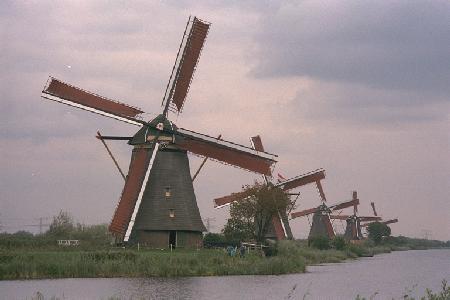
Windmills and river mills were invented and this renewable power freed up labor to do other things, like go off and invent steam engines.

Other times technology has saved us are the taming of fire (we could cook tough plants previously unable to be eaten raw), the invention of agriculture, the green revolution etc.
So I guess we could say there is precedent for us escaping from bottlenecks.
Now we are faced with a bottleneck of how to get our energy system off of oil before it begins it's precipitous decline.
Hubbert himself argued that nuclear would be the next big thing. I won't call him a liar, but I will say that nuclear though it could do so all by itself, is not our only solution.
Every day we have more wind and more sunlight coming into the Earth energy system than our entire world consumption for a year.
It's also worthwhile pointing out that while oil in in imminent danger of depletion during the next decade, this is not true of either natural gas or coal. So any transition period could be partially backed up by natural gas or coal.
Both of these are good substitutes for oil if a little expensive to get them into liquid form. But we have plenty for now.
In the meantime, the build rate of wind is scaling up at 35% increase in global installed base every five years and accelerating. Likewise solar. Nuclear is hardly budging in North America and Europe but China is growing it's installed base of nuclear at half the rate it's growing it's wind. It's also worth pointing out that we have several regions with large installed bases of Nuclear already. i.e. they don't need any more. France and Ontario are two such regions. Sweden is another.
What does electricity have to do with oil depletion?
Plenty as it happens. Up till this decade the closest substitute for oil powered transportation such as automobiles and 18 wheeler trucks was biofuel and natural gas.
Well we have a glut of natural gas right now so that's not such a problem.
Previously, though, that was it. Sure there were electric trains and electric streetcars and trolley buses etc, but in many regions the streetcars and trolley buses are now gone and replaced with interstate networks.
In a pinch we *could* rebuild the streetcar networks and in fact, many countries are in fact doing so. The notable laggards are the UK, Canada and the United States.
To be fair, though, most Canadian cities already have electric mass transit systems of some sort. Even Calgary which is the oil capital, has the electric C-Train. Toronto's mass transit system is electric and world class.

But what about systems that are not point to point, like bus based networks or the logistics networks of supermarkets?
Well as it turns out we have a model for the logistics networks from 1950s Britain.
They are called milk floats. 30 mile range, slow moving lead acid battery powered delivery vehicles. Using even this basic technology combined with electric trains, the logistics network of the 1950s could even then have been run off of electricity.
Sadly, though, this technology fell out of favor and was replaced by the more versatile diesel truck with a higher speed and a better range.
In a pinch, however, if need be, we could get by with a 1950s logistics network.
But we don't have to. Batteries have advanced so much in the last ten years that we now have 13 ton trucks with a top speed of 65mpg and a range of greater than 150 miles. Easily adequate to run a logistics fleet.

If we ignore for a minute that in the same time frame they used streetcars and trolley buses in place of the diesel powered buses we have now, what are our current options?
Well as it happens, we also have in recent times developed high speed, decent range elecetric buses such as Proterra buses which can be charged to 80% capacity in 10 minutes. With a range of 100 miles, a ten minute charge gets an additional 80 miles.
This can easily be adapted to virtually any modern bus service.
Now the question will no doubt arise from our doomer friends: where will we get all the electricity to do this if we have millions of electric trucks and electric buses?
The answer is simple: we will build more gas plants, coal plants, nuke plants and more windmills.

Production capacity to build all these electric vehicles will take some time to ramp up but in the meantime it's very straightforward to convert to natural gas. And like New Zealand did in the 1970s during the last oil crunch (where they converted up to 10% of their fleet to natural gas) we will likely do the same, all the while, gradually building up an all electric fleet.

Now one point that's not been adequately covered is the rate of advance we've seen in the last ten years and then a comparison of where we are now and where we will be ten years from now.
When I originally freaked out after reading dieoff.org all those years ago, battery tech had hardly advanced since the 1950s. Sure there were NiCad and Nickel Metal Hydride, but the energy density and the range was only 2-3 times that of lead acid batteries. That meant you had literally tons of weight for a range of, say 50-70 miles which took 10 hours to charge.
Compared with a standard automobile or truck which could be recharged at a gas station in ten minutes by filling up and then drive for hundreds of miles, clearly the existing technology at the time was a poor substitute. I've already argued that it was a "good enough" substitute to keep the lights on and food in the supermarkets, but certainly not good enough to have all electric hummers.
Are we there yet?
i.e. can we have all electric hummers with a 200 mile range?
Unfortunately with the current best-of-breed batteries (Lithium Ion) we cannot.
We have 13 ton trucks with a 150 mile range than take ten hours to charge or can charge to 100 mile range in half an hour.
Likewise we have smaller personal automobiles like the Th!nk city with a range of about 100 miles which take 4 hours to recharge or else a range of 80 miles after a fast charge of 30 minutes. The Tesla Sportscar is similar. 200 mile range in ten hours or 150 mile range with an hour fast charge.
Clearly these are adequate to keep more or less the current paradigm running. They are not, however, a complete replacement.
Is a complete replacement even possible with batteries? Well with current generations of batteries no.
But there are several breakthroughs on the horizon it has to be pointed out.
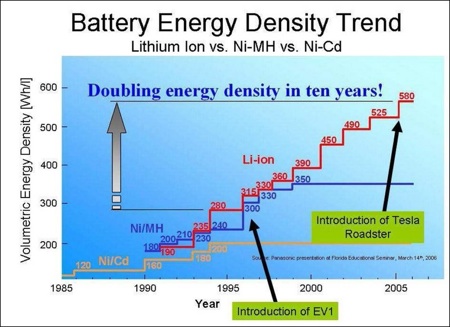
There's this:
"Air fueled battery has 10 times the energy density of current lithium ion batteries"
So we could have a small car with a range of 1000 miles. Surely acceptable.
Do you think we could maybe have a Hummer with a 150 mile range?
There's this:
"New Lithium Battery can store three times the energy of conventional lithium batteries"
http://www.sciencedaily.com/releases/2009/05/090518111731.htm
So a 450 mile range on a small cheap car or else a hummer with a 75 mile range?
Acceptable to anybody? I'd say yes.
And there's this:
"MIT Lithium Battery could recharge in seconds rather than hours"
Hmmm. If we combine a 450 mile range battery with recharging in seconds, can we say that's a perfect replacement for what we have now?
And last but not least there's this:
"Project Better Place will provide a network of battery swap stations that will allow owners of electric cars to have a depleted battery swapped for a fully charged one in a drive through station like a car-wash, all in less time than it takes to fill the gas tank of a conventional car"
http://www.betterplace.com/solution/charging/
So unlike the opinion of the dieoff crowd that technology won't save us. I'd have to disagree. Not only will technology save us, but it will be a pre-existing old technology that will save us: the humble battery.
For those with more interest in this topic,
please also visit peakoildebunked and ghawareguzzler as well as sciencedaily, newscientist and greencarcongress.
Tuesday, 19 May 2009
No Substitutes to Oil?
Over at dieoff.org, which is the scariest peak oil site bar none out there, one of the main tenets is that there are "no substitutes" and that renewables contribute only a little and will never contribute more than a little.
In fact, there are many substitutes and they are contributing all over the world and in many industries.
The main area where peak oil is likely to be a problem is transportation.
Do we have a substitute for oil in transportation?
Well yes we do.
Batteries and electrified transit systems.
There are at least five examples of huge electrified systems that I can think of off the top of my head (and several lesser ones). They are: The New York Subway, The Paris Metro, The London Underground , The Tokyo Subway and the Mexico City Underground. Smaller systems include the Dublin Bart, The Glasgow Underground, the Portland Light Rail system, the BART system, The Toronto Underground and Streetcar system and The Calgary C-Train among others. I'm sure others could list several more electrified systems.
Now, that's all well and good, but the electricity to power these systems has to come from somewhere.
Dieoff.org posits that when oil peaks, the lights will go out and then we will end up a few years later back at "olduvai gorge" levels of technology.
In fact, electricity doesn't come from oil in the majority of cases.
There are five main sources worldwide: coal, natural gas, hydro-electric, wind and nuclear. Others such as solar are neglible but fast growing.
The dieoff crowd, however, would try to backpedal the argument "but electricity doesn't use oil in most cases" by saying, "yes, but trucks use oil and the electric grid needs trucks to service the infrastructure. When enough parts wear out and there are no trucks to take the maintenance crews out there, the grid will eventualy fail".
Perhaps if there really were no alternatives to petroleum powered trucks. And right now, they are indeed mostly petroleum (gasoline or diesel) powered.
Currently.
There are alternatives, however, especially electric trucks.
Although there are not huge volumes of them in operation or in production, they could be produced in large volumes and they certainly do work as an acceptable substitute, especially examples from outfits like Smith Electric Vehicles with 13.5 ton trucks which have a top speed of 65mph and a range of 150 miles. Not too shabby. This is admittedly a new technology and to be fair to dieoff.org it wasn't available at the time the original site was put up, but the technology works for sure.
That said, we have had functional electric trucks for decades. This is not a new and untested technology. In the UK, milk was commonly delivered by electric trucks called "milk floats" from the end of the second world war up until the early 80s. Hardly a novel technology that "does not work". Sure they are based on decades old lead-acid batteries, but it would be a stopgap for transporting parts from a warehouse to any sub-stations on the grid.
As for energy sources for the grid, as said we have coal, natural gas, hydro-electric, wind and nuclear.
Of coal, we have pessimistically another fifty years worth at current rates of consumption and optimistically a hundred years worth. Of natural gas, there have recently been new technology breakthroughs that permit far better utilization of stranded natural gas than was possible before. This is especially the case with shale gas. Natural gas will of course peak, but there is sufficient for at least the next decade if not globally then certainly in North America and other areas with abundant shale formations. Nuclear is a good case in point too and was actually the solution posited by Hubbert himself to the then impending global peak in oil production that he foresaw. Hydro-electric is old technology like lead-acid batteries, and significant resource is already in place and going nowhere when oil peaks. Large scale examples of this are Ontario Hydro and Quebec Hydro as well as the Hoover Dam. China is building massive new hydro resource as we speak. Wind and Solar are interesting and ultimately we must depend on them.
According to dieoff, renewables such as wind will never make much of a difference. I beg to differ.
In a handful of regions, 20% of the electric power is supplied by wind and there's no real reason it couldn't go higher. Right now wind power is on parity with new coal and new nat gas plant on a lifecycle basis which makes it both a technical substitute and a price based substitute.
The big argument against wind is that due to it's intermittency it cannot ever get higher than a 20% penetration.
In fact, this is not the case. Even though it's true that a single geographic windfarm could conceivably be without wind, this is very unlikely to be the case with many geographically dispersed windfarms. The solution to the problem is more grid connections to make sure power can move from where the wind is blowing to the centers of consumption. Recent studies by a scientist named Gregor Czisch have shown that not only can this be done, but the cost is favorable. To quote an article in new scientist magazine "The wind is always blowing somewhere, just as the sun is always shining on half the globe. So with a large enough grid, variations in generation should even out, giving a reliable supply.
The project would cost more than €1.5 trillion, of which €128 billion would go on the lines and equipment for the supergrid itself, and around €1.4 trillion on renewable-generating capacity. To put this in context, the International Energy Agency forecasts that the global power industry will have to invest $13.6 trillion on fossil-fuel-based power generation by 2030."
So sure, we are currently not in the position where we have a continental or even a global super grid capable of taking renewable power from where it's generated to where it's needed, but it roundly debunks the point that it will never be done because it cannot be done.
So the remaining argument is this: What resilience is left in the system to get substitutes online quickly if depletion sets in starting tomorrow?
Well to answer that we need to ask the following question:
Are there any regions of the world that are currently significantly supplied with either nuclear or renewable electricity that also have a reasonable manufacturing base or at least the capability to ramp up quickly.
As it happens there are.
Ontario is mostly hydro and nuclear as is Quebec. Both are heavy manufacturing regions.
France sources most of it's electricity from nuclear. Switzerland sources most of it's electricity from hydro. Germany is in a relatively weaker position, but it is the largest user in the world of both solar and wind and is also a heavy manufacturing superpower. Japan, though it has no fossil fuels of it's own, supplies most of it's electricity from nuclear and tokyo which is a huge manufacturing region, just happens to have a world class metro system. Norway, which has abundant hydro power, also has one of the world's most electrified mass transit systems in the form of a high speed electric rail network, electric streetcars in oslo and an electric metro system. It is also home to the manufacturing facilities of Th!nk Electric, one of the two well known brands of electric cars with reasonable price and performance (the other is Tesla of California).
So it seems that even if depletion comes calling and it is severe, there are at least a handful of regions that have the ability to substitute. I'd wager that in such a scenario, rather than a global collapse back to the stone age and mass dieoff we'd really be facing what would amount to a transfer of manufacturing to these regions that are powered by renewables and nuclear. From there a bright renewable future would eventually emerge. And that's the WORST scenario.
Olduvai gorge?
Whatever.
In fact, there are many substitutes and they are contributing all over the world and in many industries.
The main area where peak oil is likely to be a problem is transportation.
Do we have a substitute for oil in transportation?
Well yes we do.
Batteries and electrified transit systems.
There are at least five examples of huge electrified systems that I can think of off the top of my head (and several lesser ones). They are: The New York Subway, The Paris Metro, The London Underground , The Tokyo Subway and the Mexico City Underground. Smaller systems include the Dublin Bart, The Glasgow Underground, the Portland Light Rail system, the BART system, The Toronto Underground and Streetcar system and The Calgary C-Train among others. I'm sure others could list several more electrified systems.
Now, that's all well and good, but the electricity to power these systems has to come from somewhere.
Dieoff.org posits that when oil peaks, the lights will go out and then we will end up a few years later back at "olduvai gorge" levels of technology.
In fact, electricity doesn't come from oil in the majority of cases.
There are five main sources worldwide: coal, natural gas, hydro-electric, wind and nuclear. Others such as solar are neglible but fast growing.
The dieoff crowd, however, would try to backpedal the argument "but electricity doesn't use oil in most cases" by saying, "yes, but trucks use oil and the electric grid needs trucks to service the infrastructure. When enough parts wear out and there are no trucks to take the maintenance crews out there, the grid will eventualy fail".
Perhaps if there really were no alternatives to petroleum powered trucks. And right now, they are indeed mostly petroleum (gasoline or diesel) powered.
Currently.
There are alternatives, however, especially electric trucks.
Although there are not huge volumes of them in operation or in production, they could be produced in large volumes and they certainly do work as an acceptable substitute, especially examples from outfits like Smith Electric Vehicles with 13.5 ton trucks which have a top speed of 65mph and a range of 150 miles. Not too shabby. This is admittedly a new technology and to be fair to dieoff.org it wasn't available at the time the original site was put up, but the technology works for sure.
That said, we have had functional electric trucks for decades. This is not a new and untested technology. In the UK, milk was commonly delivered by electric trucks called "milk floats" from the end of the second world war up until the early 80s. Hardly a novel technology that "does not work". Sure they are based on decades old lead-acid batteries, but it would be a stopgap for transporting parts from a warehouse to any sub-stations on the grid.
As for energy sources for the grid, as said we have coal, natural gas, hydro-electric, wind and nuclear.
Of coal, we have pessimistically another fifty years worth at current rates of consumption and optimistically a hundred years worth. Of natural gas, there have recently been new technology breakthroughs that permit far better utilization of stranded natural gas than was possible before. This is especially the case with shale gas. Natural gas will of course peak, but there is sufficient for at least the next decade if not globally then certainly in North America and other areas with abundant shale formations. Nuclear is a good case in point too and was actually the solution posited by Hubbert himself to the then impending global peak in oil production that he foresaw. Hydro-electric is old technology like lead-acid batteries, and significant resource is already in place and going nowhere when oil peaks. Large scale examples of this are Ontario Hydro and Quebec Hydro as well as the Hoover Dam. China is building massive new hydro resource as we speak. Wind and Solar are interesting and ultimately we must depend on them.
According to dieoff, renewables such as wind will never make much of a difference. I beg to differ.
In a handful of regions, 20% of the electric power is supplied by wind and there's no real reason it couldn't go higher. Right now wind power is on parity with new coal and new nat gas plant on a lifecycle basis which makes it both a technical substitute and a price based substitute.
The big argument against wind is that due to it's intermittency it cannot ever get higher than a 20% penetration.
In fact, this is not the case. Even though it's true that a single geographic windfarm could conceivably be without wind, this is very unlikely to be the case with many geographically dispersed windfarms. The solution to the problem is more grid connections to make sure power can move from where the wind is blowing to the centers of consumption. Recent studies by a scientist named Gregor Czisch have shown that not only can this be done, but the cost is favorable. To quote an article in new scientist magazine "The wind is always blowing somewhere, just as the sun is always shining on half the globe. So with a large enough grid, variations in generation should even out, giving a reliable supply.
The project would cost more than €1.5 trillion, of which €128 billion would go on the lines and equipment for the supergrid itself, and around €1.4 trillion on renewable-generating capacity. To put this in context, the International Energy Agency forecasts that the global power industry will have to invest $13.6 trillion on fossil-fuel-based power generation by 2030."
So sure, we are currently not in the position where we have a continental or even a global super grid capable of taking renewable power from where it's generated to where it's needed, but it roundly debunks the point that it will never be done because it cannot be done.
So the remaining argument is this: What resilience is left in the system to get substitutes online quickly if depletion sets in starting tomorrow?
Well to answer that we need to ask the following question:
Are there any regions of the world that are currently significantly supplied with either nuclear or renewable electricity that also have a reasonable manufacturing base or at least the capability to ramp up quickly.
As it happens there are.
Ontario is mostly hydro and nuclear as is Quebec. Both are heavy manufacturing regions.
France sources most of it's electricity from nuclear. Switzerland sources most of it's electricity from hydro. Germany is in a relatively weaker position, but it is the largest user in the world of both solar and wind and is also a heavy manufacturing superpower. Japan, though it has no fossil fuels of it's own, supplies most of it's electricity from nuclear and tokyo which is a huge manufacturing region, just happens to have a world class metro system. Norway, which has abundant hydro power, also has one of the world's most electrified mass transit systems in the form of a high speed electric rail network, electric streetcars in oslo and an electric metro system. It is also home to the manufacturing facilities of Th!nk Electric, one of the two well known brands of electric cars with reasonable price and performance (the other is Tesla of California).
So it seems that even if depletion comes calling and it is severe, there are at least a handful of regions that have the ability to substitute. I'd wager that in such a scenario, rather than a global collapse back to the stone age and mass dieoff we'd really be facing what would amount to a transfer of manufacturing to these regions that are powered by renewables and nuclear. From there a bright renewable future would eventually emerge. And that's the WORST scenario.
Olduvai gorge?
Whatever.
Thursday, 20 March 2008
EROEI for doomers debunked
The EROEI myth debunked.
The concept of EROEI.
It stands for Energy Return on Energy Invested.
The party line:
The original oil get an energy return of one hundred barrels of oil for each barrel of oil equivalent that was put in. Since oil is getting harder and harder to extract we are now down to one barrel of oil equivalent gets twenty barrels of oil out.
The reader is invited to extrapolate all the way down the curve and conclude that we are sliding down the curve till it will take more than one barrel of oil equivalent to get one barrel of oil out.
When we hit that stage it will not be possible to get any more oil out and we will leave it in the ground.
There is nothing wrong with the mathematics there, but let's examine the assumptions.
Barrels of oil and Barrels of oil equivalent.
There is a difference between barrels of oil and barrels of oil equivalent.
On the one hand we have barrels of oil equivalent sitting in the ground that when they are used up they are gone. (Oil, Natural Gas, Tar Sands, Nuclear fuel etc).
On the other hand we have barrels of oil equivalent that are not sitting in the ground but are replenished every day. Sunlight is one such barrel of oil equivalent and it is the basis of all of the other barrels of oil equivalents like wind, wave, oil, natural gas and tar sands. Only nuclear does not come from the sun.
The problem with this definition is it invites us to think of energy as barrels of oil instead of just energy. Thus we are led to the idea that you need to burn up barrels of oil equivalent to get some more barrels of oil equivalent back.
In the case of oil, natural gas, tar sands and nuclear this is indeed exactly the case.
The Second Law of Thermodynamics
Some people over at TOD quote quite correctly that Net Energy = Energy In - Energy Out. In the context of barrels of oil to get barrels of oil it looks like we have a dimishing resource and once it's gone we have no energy left. They then go on to say that the second law of thermodynamics says we will run out of energy because we need to use up barrels of oil to get more barrels of oil. This is part of the same fallacy propounded by Jay Hansen all those years ago. In fact the second law of thermodynamics says that "in the absence of energy being added to the system, the amount of energy in the system always runs down". This is a more helpful way of describing Net Energy = Energy In - Energy Out because it makes you realize that we're not living in a closed system with a limited stock of energy. Sunlight is continually pouring in. We have a full tank of sunlight and every morning it is refilled. This new tank of energy is added to the system every morning.
The final part of the fallacy is where they do an EROEI calculation on windmills and other forms of energy harvesting infrastructure but only using barrels of oil as an input. This is fundamentally wrong headed.
The reason is that if you artificially constrained the system to use only barrels of oil to get barrels of oil instead of barrels of oil equivalent to get barrels of oil equivalent you'd conclude that you need to burn up energy to get energy. In the case of the oil to get oil this is true. Thus saying "I burned a barrel of oil to get 20 barrels back" would make sense. The net result is 19 barrels of oil after one is used and it's a continual processing of burning barrels up till you have none left.
In the case of a wind turbine, however, you build the windmill and then it provides energy. If you use that energy to build another windmill, the first windmill is still there. So let's use EROEI in the correct context for a windmill.
Taking the ridiculously low extrapolation of a 20% return on energy invested what that means is that for every four barrels of oil you burn you get one back. This is equivalent to spending the principal.
Obviously not good as your supply is diminishing at an every increasing rate and a inversely corresponding larger amount of your economy has to go towards creating energy.
In the case of a windmill, though, what it means is fundamentally different. For every four windmills that are built, you get one free one and the other four are still there. Now you have five. Using the concept of EROEI here means that the interest is compounding. This is equivalent to investing the principal and growing it. The economy here would be growing, not contracting and an ever diminishing share of the economy would be going towards producing energy unlike in the case of using oil to produce oil.
Anyone who has studied compound interest knows that there is a doubling time. Let's look at that.
In the case of the ridiculously low EROEI of 1.2 quoted on the oil drum, that's a 20% rate of interest. The doubling time is about four years. Now even if you had to use half of that, you would still be left with 10% interest on your original principal. That means that your installed base of energy doubles every ten years and ultimately, this will result in many windmills.
ECONOMIES OF SCALE AND DIMINISHING RETURNS
These two concepts are related but opposed to each other but it's important to include them here because they apply in opposite ways to renewable energy and fossil fuels.
Economies of scale is where the bigger the manufacturing facility you build the more efficient it becomes. With windmills, the bigger the windmill is the more power you can get out of the wind due to it being a power cube rule. This means that the bigger the factories are to produce the windmills, the compounding effects means we get a higher and higher EROEI as we go. The economy can thus grow quicker and quicker.
Diminishing returns means that the more effort you put into something the less return you get back out. Oil is like this. The harder you suck it out, the faster you use it up. In an economy dependent on oil, more and more of the economy is used up to get the oil out faster and faster and ultimately it will collapse if there is no alternative to oil.
What is the conclusion?
Jay Hansen did us all a big disservice by propounding the myth that we need oil to get oil. He did us a worse disservice by inviting us to measure EROEI in barrels of oil equivalent leading us to think that the ability to extract energy was diminishing. This is the same myth that is being propouned on the oil drum. They claim that ultimately we will get down to 1 or less whereas in fact we will never even get down to the 1.2 I used for the argument. There is no possibility except perhaps in the case of nuclear war that declining eorei of conventional oil is going to lead to cannibalism as per "The Road". Even solar panels are better than that (1.2 factor return), and though the EROEI of oil is decreasing if we mistakenly use only the diminishing quantity remaining barrels of oil to calculate it, we still have that full tank of sunlight every morning to use up so we have a floor under us of the lowest EROEI of renewable energy devices (solar PV) which is more like 4.0-8.0 depending on whose calculations you use. So if we have renewable energy to create more renewable energy devices we can still have a growth economy up to the limits of resources on this finite world. But we have no problem of for ever diminishing returns on EROEI waiting for us up ahead. One day we will in fact find that it's pointless using electricity to pull oil out of the ground or make syncrude out of the tar sands, but way before we reach that point we will have already clued in to the fact that we can get by on electricity by using it directly instead of wasting it digging up or making oil.
The concept of EROEI.
It stands for Energy Return on Energy Invested.
The party line:
The original oil get an energy return of one hundred barrels of oil for each barrel of oil equivalent that was put in. Since oil is getting harder and harder to extract we are now down to one barrel of oil equivalent gets twenty barrels of oil out.
The reader is invited to extrapolate all the way down the curve and conclude that we are sliding down the curve till it will take more than one barrel of oil equivalent to get one barrel of oil out.
When we hit that stage it will not be possible to get any more oil out and we will leave it in the ground.
There is nothing wrong with the mathematics there, but let's examine the assumptions.
Barrels of oil and Barrels of oil equivalent.
There is a difference between barrels of oil and barrels of oil equivalent.
On the one hand we have barrels of oil equivalent sitting in the ground that when they are used up they are gone. (Oil, Natural Gas, Tar Sands, Nuclear fuel etc).
On the other hand we have barrels of oil equivalent that are not sitting in the ground but are replenished every day. Sunlight is one such barrel of oil equivalent and it is the basis of all of the other barrels of oil equivalents like wind, wave, oil, natural gas and tar sands. Only nuclear does not come from the sun.
The problem with this definition is it invites us to think of energy as barrels of oil instead of just energy. Thus we are led to the idea that you need to burn up barrels of oil equivalent to get some more barrels of oil equivalent back.
In the case of oil, natural gas, tar sands and nuclear this is indeed exactly the case.
The Second Law of Thermodynamics
Some people over at TOD quote quite correctly that Net Energy = Energy In - Energy Out. In the context of barrels of oil to get barrels of oil it looks like we have a dimishing resource and once it's gone we have no energy left. They then go on to say that the second law of thermodynamics says we will run out of energy because we need to use up barrels of oil to get more barrels of oil. This is part of the same fallacy propounded by Jay Hansen all those years ago. In fact the second law of thermodynamics says that "in the absence of energy being added to the system, the amount of energy in the system always runs down". This is a more helpful way of describing Net Energy = Energy In - Energy Out because it makes you realize that we're not living in a closed system with a limited stock of energy. Sunlight is continually pouring in. We have a full tank of sunlight and every morning it is refilled. This new tank of energy is added to the system every morning.
The final part of the fallacy is where they do an EROEI calculation on windmills and other forms of energy harvesting infrastructure but only using barrels of oil as an input. This is fundamentally wrong headed.
The reason is that if you artificially constrained the system to use only barrels of oil to get barrels of oil instead of barrels of oil equivalent to get barrels of oil equivalent you'd conclude that you need to burn up energy to get energy. In the case of the oil to get oil this is true. Thus saying "I burned a barrel of oil to get 20 barrels back" would make sense. The net result is 19 barrels of oil after one is used and it's a continual processing of burning barrels up till you have none left.
In the case of a wind turbine, however, you build the windmill and then it provides energy. If you use that energy to build another windmill, the first windmill is still there. So let's use EROEI in the correct context for a windmill.
Taking the ridiculously low extrapolation of a 20% return on energy invested what that means is that for every four barrels of oil you burn you get one back. This is equivalent to spending the principal.
Obviously not good as your supply is diminishing at an every increasing rate and a inversely corresponding larger amount of your economy has to go towards creating energy.
In the case of a windmill, though, what it means is fundamentally different. For every four windmills that are built, you get one free one and the other four are still there. Now you have five. Using the concept of EROEI here means that the interest is compounding. This is equivalent to investing the principal and growing it. The economy here would be growing, not contracting and an ever diminishing share of the economy would be going towards producing energy unlike in the case of using oil to produce oil.
Anyone who has studied compound interest knows that there is a doubling time. Let's look at that.
In the case of the ridiculously low EROEI of 1.2 quoted on the oil drum, that's a 20% rate of interest. The doubling time is about four years. Now even if you had to use half of that, you would still be left with 10% interest on your original principal. That means that your installed base of energy doubles every ten years and ultimately, this will result in many windmills.
ECONOMIES OF SCALE AND DIMINISHING RETURNS
These two concepts are related but opposed to each other but it's important to include them here because they apply in opposite ways to renewable energy and fossil fuels.
Economies of scale is where the bigger the manufacturing facility you build the more efficient it becomes. With windmills, the bigger the windmill is the more power you can get out of the wind due to it being a power cube rule. This means that the bigger the factories are to produce the windmills, the compounding effects means we get a higher and higher EROEI as we go. The economy can thus grow quicker and quicker.
Diminishing returns means that the more effort you put into something the less return you get back out. Oil is like this. The harder you suck it out, the faster you use it up. In an economy dependent on oil, more and more of the economy is used up to get the oil out faster and faster and ultimately it will collapse if there is no alternative to oil.
What is the conclusion?
Jay Hansen did us all a big disservice by propounding the myth that we need oil to get oil. He did us a worse disservice by inviting us to measure EROEI in barrels of oil equivalent leading us to think that the ability to extract energy was diminishing. This is the same myth that is being propouned on the oil drum. They claim that ultimately we will get down to 1 or less whereas in fact we will never even get down to the 1.2 I used for the argument. There is no possibility except perhaps in the case of nuclear war that declining eorei of conventional oil is going to lead to cannibalism as per "The Road". Even solar panels are better than that (1.2 factor return), and though the EROEI of oil is decreasing if we mistakenly use only the diminishing quantity remaining barrels of oil to calculate it, we still have that full tank of sunlight every morning to use up so we have a floor under us of the lowest EROEI of renewable energy devices (solar PV) which is more like 4.0-8.0 depending on whose calculations you use. So if we have renewable energy to create more renewable energy devices we can still have a growth economy up to the limits of resources on this finite world. But we have no problem of for ever diminishing returns on EROEI waiting for us up ahead. One day we will in fact find that it's pointless using electricity to pull oil out of the ground or make syncrude out of the tar sands, but way before we reach that point we will have already clued in to the fact that we can get by on electricity by using it directly instead of wasting it digging up or making oil.
Subscribe to:
Posts (Atom)