So things are getting interesting in the battery arena.
Right now we have batteries for electric cars that cost around $20,000 for 150 mile range, which while it will avert a collapse in the transportation and logistics network if it is all we have (it's not), the price is currently so high that it's not *very* competitive with lower end internal combustion based engines.
We really need at a minimum, double the range and half the price to bring costs and utility to a level at which the average buyer of today's vehicles will purchase them on mass.
Even better, obviously would be a battery which has three times the range and half the cost or less of today's batteries.
Well as it happens, the batteries we are using today are 2003's technology. While it may be frustrating to watch that it's taking something like 9 years to produce batteries with adequate range and pricing, compared with information technology which improves by 2X it's performance every 18 months, we are nearly there. As I make it there are now four viable improved battery technologies in the lab at a pre-production stage. There are, in fact, more than four promised technologies but if we put faith in batteries promised by large organizations with the funding and the process, engineering and production capacity to actually bring the technology to market in any kind of meaningful way then there are four.
They are:
IBM's battery 500 which is the result of millions of hours of supercomputer advanced simulation of different chemistries of anodes and cathodes for the holy grail of lithium batteris: lithium air. If this battery is real then it will have a 500 mile range for the same cost as today's batteries. Definitely adequate. On an off topic note, I wish there was a paper somewhere explaining how their model worked, because the way they rapidly scanned over 20 million chemicals make me suspect AI was somehow involved and that would be even bigger news than just a new battery. IBM promises to have a prototype ready by 2013 and if successful, it hopes a battery manufacturer will license the technology and be in production by 2020.
Toshiba's SCiB lithium titanate battery with double the range and the same cost, coming to market in 2013.
Nissan has developed a new better anode in it's battery which it uses in the Nissan leaf which currently has a 100 mile range. It plans to release these new batteries with double the range in 2015.
Altairnano, LG Chem and A123 Systems all have a variety of more efficient cathode's for more advanced lithium ion batteries with lower costs.
It's also worth pointing out that there are also magnesium chemistry batteries in the lab as well as Iron phosphate lithium batteries and various other technologies being worked on that are further away from the market.
Now a corrollary to the battery advances and cost reductions is the reduction in intermittency of renewable sources of electricity such as wind and solar. The problem of intermittency isn't really a problem of technology, since we already have technical solutions to these problems: geographic dispersement of wind farms, hydro storage, compressed air, vanadium flow batteries etc etc, it's really a problem of price (same as with electric cars). If prices of batteries become low enough that they can be added on existing electric renewable infrastructure with no large scale increase in price to the consumer it will be a no brainer to do so.

Showing posts with label Batteries. Show all posts
Showing posts with label Batteries. Show all posts
Sunday, 20 November 2011

Wednesday, 19 October 2011
Electric Car: Batteries cross the finish line
Toshiba just announced that it will be producing a lithium-ion solid state millable sheet fabricated battery with high energy density starting in the 2015 timeframe.
The energy densities are about 3X the current energy density for the best li-ion batteries currently on the market with about the same cost and 1/3 the volume. So instead of a battery that costs $20,000 and delivers a range of 200KM in something like a leaf we're talking about the same size of battery by volume, the same price but a 600KM range. For those who can't do kilometers that's about a 400 mile range.
I know we've heard this before this decade with various different small companies but this is one of the big boys who are generally speaking able to deliver on promises and are nearly always late to the party. There are likely to be even better (in terms of price) technologies out there that are not ready.
My take on this is that we have now crossed the finish line technically and all that's left is the process engineering and the building of the plants.
If the ultimate costs are 2X what they currently are for vehicles then either some people are going to have to stop driving or else it will take longer to pay for a car. Either way we're now at a reasonable range since the likelihood anyone needs to drive more than 400 miles in a day is small compared to all the times you will need to drive far less than 400 miles in a day.
It's going to be an interesting decade.
The energy densities are about 3X the current energy density for the best li-ion batteries currently on the market with about the same cost and 1/3 the volume. So instead of a battery that costs $20,000 and delivers a range of 200KM in something like a leaf we're talking about the same size of battery by volume, the same price but a 600KM range. For those who can't do kilometers that's about a 400 mile range.
I know we've heard this before this decade with various different small companies but this is one of the big boys who are generally speaking able to deliver on promises and are nearly always late to the party. There are likely to be even better (in terms of price) technologies out there that are not ready.
My take on this is that we have now crossed the finish line technically and all that's left is the process engineering and the building of the plants.
If the ultimate costs are 2X what they currently are for vehicles then either some people are going to have to stop driving or else it will take longer to pay for a car. Either way we're now at a reasonable range since the likelihood anyone needs to drive more than 400 miles in a day is small compared to all the times you will need to drive far less than 400 miles in a day.
It's going to be an interesting decade.
Wednesday, 29 June 2011
So how much would it cost to drive if the world was 100% fueled by renewables?
I haven't been posting much because I've basically been smugly sitting back on my butt waiting for the market to take care of a bunch of the problems we're going to face even before peak oil arrives in a hard way around 2015. But it's nearly the summer and I've been thinking a little about what the world would look like if we had to run it off of electricity derived purely from renewables. We don't of course because we have brickloads of nuclear and shale gas as well as unconventional oil (which will of course eventually peak and decline but not today or next week or next decade even).
So let's get to the meat:
Doomers basically say we're screwed no matter what we do, so let's ignore them. Detractors on the other hand are not religious fanatics (generally), just highly conservative late adopters. The type of person who still buys CDs instead of downloading music from itunes for example.
So anyways. Let's take a look at the question above.
Well, let's establish some baselines. I have previously established that in certain areas we already have par with fossil fuels for solar and wind but let's assume that they are 2X as expensive.
So we're still stuck right? Because the sun doesn't always shine and the wind doesn't always blow?
Wrong. The missing but implicit assumption that isn't talked about is this: we could store the energy in batteries or salt mines or whatever, just that it's EXPENSIVE to do so.
Well what does that mean? Well let's take Vanadium flow batteries as an example. They add between 1.5X to 3X the cost depending on whose figures you take.
So that means if we're being uncharitable to renewables we are looking at 3X to 6X the cost of current electricity if we use the most expensive means of storage.
So let's take a look at that.
Right now in North America, the cost of a kilowatt hour varies between about 10c and 25c.
Let's look at the most inefficient electric vehicle: the Volt. It has to carry around a gasoline engine in addition to it's electric motors (something like the leaf would be better but let's use the Volt as our baseline).
The Volt uses 8 KW/h of electricity to drive 40 miles. That's a reasonable comparison to a gallon of gas in a car that size. So the equivalent of a gallon of gas for a Volt at today's prices is between 80c/gallon and $2 a gallon. That's compared to close to $4 a gallon for gasoline/diesel based vehicles (ignoring the fact that most North American vehicles only get 15-20 mpg but let's ignore that inconvenient fact for now).
So if it costs 80c a gallon at 10c per KW/h then using our estimate for the most expensive storage methods we're looking at between $1.20 per gallon and $2.40 per gallon equivalent. Still cheaper than today's gasoline prices.
If we take the high end at 25c per KW/h as being $2 per gallon then we're looking at between $3 and $6 per gallon.
Now $6 a gallon will have most North Americans weeping in their beer but most of the rest of the world is ALREADY paying more than that TODAY .
To be sure if Americans had to pay $6 every 40 miles driven I doubt there would be so many trips to the ocean or the mountain or stupid trips like driving to NYC from the midwest to pick up some furniture and then back again. But North Americans being resilient folk would figure out how to get around minor problems like that and continue on their merry way.
On another note: one of the problems with Solar Panels Cost right now is that most of the material is wasted during the deposition process. It would be nice if someone could come up with a way to reduce wastage so that the costs could drop. Especially since the Chinese (as is their right) have hiked prices on rare earths to try to force high tech manufacturing to move to China (where the internal price is lower). Anyways, as it happens one of the technical departments in an Oregon university (I forget if it's OSU or PSU) has developed a process to use a type of inkjet printing which should reduce costs. Now if we take the word "most" (as in most of the material is wasted) to mean merely 51% of the material is wasted then we're looking at a 50% drop in materials costs. As materials costs for solar panels are about 2/3 of the final store price, we're looking at a 33% reduction in price for the end consumer. Not too shabby, considering that we're already at par with fossil fuels for the Southern States and Mediterranean Europe.
Interesting times.
So let's get to the meat:
Doomers basically say we're screwed no matter what we do, so let's ignore them. Detractors on the other hand are not religious fanatics (generally), just highly conservative late adopters. The type of person who still buys CDs instead of downloading music from itunes for example.
So anyways. Let's take a look at the question above.
Well, let's establish some baselines. I have previously established that in certain areas we already have par with fossil fuels for solar and wind but let's assume that they are 2X as expensive.
So we're still stuck right? Because the sun doesn't always shine and the wind doesn't always blow?
Wrong. The missing but implicit assumption that isn't talked about is this: we could store the energy in batteries or salt mines or whatever, just that it's EXPENSIVE to do so.
Well what does that mean? Well let's take Vanadium flow batteries as an example. They add between 1.5X to 3X the cost depending on whose figures you take.
So that means if we're being uncharitable to renewables we are looking at 3X to 6X the cost of current electricity if we use the most expensive means of storage.
So let's take a look at that.
Right now in North America, the cost of a kilowatt hour varies between about 10c and 25c.
Let's look at the most inefficient electric vehicle: the Volt. It has to carry around a gasoline engine in addition to it's electric motors (something like the leaf would be better but let's use the Volt as our baseline).
The Volt uses 8 KW/h of electricity to drive 40 miles. That's a reasonable comparison to a gallon of gas in a car that size. So the equivalent of a gallon of gas for a Volt at today's prices is between 80c/gallon and $2 a gallon. That's compared to close to $4 a gallon for gasoline/diesel based vehicles (ignoring the fact that most North American vehicles only get 15-20 mpg but let's ignore that inconvenient fact for now).
So if it costs 80c a gallon at 10c per KW/h then using our estimate for the most expensive storage methods we're looking at between $1.20 per gallon and $2.40 per gallon equivalent. Still cheaper than today's gasoline prices.
If we take the high end at 25c per KW/h as being $2 per gallon then we're looking at between $3 and $6 per gallon.
Now $6 a gallon will have most North Americans weeping in their beer but most of the rest of the world is ALREADY paying more than that TODAY .
To be sure if Americans had to pay $6 every 40 miles driven I doubt there would be so many trips to the ocean or the mountain or stupid trips like driving to NYC from the midwest to pick up some furniture and then back again. But North Americans being resilient folk would figure out how to get around minor problems like that and continue on their merry way.
On another note: one of the problems with Solar Panels Cost right now is that most of the material is wasted during the deposition process. It would be nice if someone could come up with a way to reduce wastage so that the costs could drop. Especially since the Chinese (as is their right) have hiked prices on rare earths to try to force high tech manufacturing to move to China (where the internal price is lower). Anyways, as it happens one of the technical departments in an Oregon university (I forget if it's OSU or PSU) has developed a process to use a type of inkjet printing which should reduce costs. Now if we take the word "most" (as in most of the material is wasted) to mean merely 51% of the material is wasted then we're looking at a 50% drop in materials costs. As materials costs for solar panels are about 2/3 of the final store price, we're looking at a 33% reduction in price for the end consumer. Not too shabby, considering that we're already at par with fossil fuels for the Southern States and Mediterranean Europe.
Interesting times.
Thursday, 23 December 2010
Batteries: Are we there yet?
Are we there yet?
We might be close.
Planar Energy, a spinoff from the US Department of Energy Renewable Technology lab has developed a 3D printable solid state lithium battery with three times the energy density at half the cost of current generation Li-Ion batteries.
The hard process engineering part was to scale up the size of the batteries which had previously been difficult to do. The breakthrough is their 3D "printing style" deposition process which allows precise deposition of solid state nanoscale electrodes, doing away with the need for liquid.
Half the cost and three times the energy density?
A nissan leaf with a three hundred fifty mile range optimal conditions and two hundred mile range sub-optimal conditions would probably meet in excess of 90% of North American driving scenarios and higher still in Europe.
So are we there yet? Nearly.
We might be close.
Planar Energy, a spinoff from the US Department of Energy Renewable Technology lab has developed a 3D printable solid state lithium battery with three times the energy density at half the cost of current generation Li-Ion batteries.
The hard process engineering part was to scale up the size of the batteries which had previously been difficult to do. The breakthrough is their 3D "printing style" deposition process which allows precise deposition of solid state nanoscale electrodes, doing away with the need for liquid.
Half the cost and three times the energy density?
A nissan leaf with a three hundred fifty mile range optimal conditions and two hundred mile range sub-optimal conditions would probably meet in excess of 90% of North American driving scenarios and higher still in Europe.
So are we there yet? Nearly.
Wednesday, 3 November 2010
Yet more large format energy storage solutions
I've written before about the energy storage solutions being developed by the many innovative companies working to solve our pressing energy challenges and here is yet another:
Corvus technologies has developed an advanced lithium ion battery with 20% higher energy density than the current best-of-breed batteries. The quality engineering has been increased to such a high degree that the battery has a working life of 20+ years as compared to 8 years for previous generation batteries.
In addition, the process engineering involved has reduced the cost to a level where it's inexpensive enough to enable energy storage to become competitive enough to enable storage for wind as the battery packs come in megawatt sizes, which is a breakthrough.
Those who say renewable energy is a non-starter because of intermittency are just dead wrong and given that up to 65% of available wind is currently dumped means we could more than double capacity usage of wind turbines, thus further increasing the cost competitiveness compared to fossil fuel powered plants.
Corvus technologies has developed an advanced lithium ion battery with 20% higher energy density than the current best-of-breed batteries. The quality engineering has been increased to such a high degree that the battery has a working life of 20+ years as compared to 8 years for previous generation batteries.
In addition, the process engineering involved has reduced the cost to a level where it's inexpensive enough to enable energy storage to become competitive enough to enable storage for wind as the battery packs come in megawatt sizes, which is a breakthrough.
Those who say renewable energy is a non-starter because of intermittency are just dead wrong and given that up to 65% of available wind is currently dumped means we could more than double capacity usage of wind turbines, thus further increasing the cost competitiveness compared to fossil fuel powered plants.
Wednesday, 27 October 2010
Electric Cars: Inches away from the Goal

Only inches away from the goal.
So some good news on the electric car front.
It's my position that when we achieve the ability to produce an electric car more or less comparable in size and interior space to todays vehicles which can drive for 8-10 hours at a reasonable speed (say 60 miles an hour) and be fully recharged in a reasonable time (say less than an hour) then we have hit 100% substitution.
Well we're close to that goal.
Recently the German Electricity company Lekker Energie converted a full size Audi A2 without taking up the trunk (i.e. a fully functional Audi A2) to an all electric car. The battery was a high efficiency polymer battery produced by German company DBM Energy. What makes that battery special is that it can be recharged fully in less than 10 minutes.
The test driver, Mirko Hanneman took the car for a pretty chunk ride of 375 miles without recharging at a speed of 55 miles an hour. He did the ride in just under seven hours. He drove from Munich to Berlin and when he reached Berlin he drove around a little and did a few chores before re-connecting.
Now call me a techno-cornucopian or whatever other slur you want but I reckon that covers about 90% of the anti-electric-car whining I have heard over the last ten years.
I'll go further than that: I declare this to be victory. Given that the charging time is less than an hour we have de facto achieved 100% substitutability. Not every vehicle on the market is capable of driving 400 miles without having to refill the tank. I'd say, in fact, that nobody realistically drives until their tank is completely empty in practise either. Most people will stop after say three to four hours driving and take a rest-room break or eat something and while they're doing that likely top up the gas tank. In this case the same paradigm would apply: take a rest-room break and maybe eat something while the battery is being topped off.
You could effectively drive round the clock to the maximum realistic human ability, same as you can now, assuming of course the availability of charging points.
The point is, now all the hard technical R&D has been done.
All that's left now is process engineering and construction of a network of charging stations to get this down to a reasonable price (and process engineering is just the thing multi-national companies are expert at and given that multi-nationals are the ones with the money invested in this then I'd say what we're looking at is a slam-dunk).
So we can now say with some certainty that we have the technology available for the pieces to enable the current paradigm to continue.
So much for "dieoff".
LOL.
FYI The photo above is the Audi A2: kind of like a small-ish SUV. Other than die-hard pickup freaks, this would be more than adequate for the average North American driver and certainly surpasses the average rest-of-world vehicle.
Tuesday, 17 August 2010
Peak Rare Earths and Electric Cars - Doom by shortage?
Some doomers reckon that we are not only going to enter a period where conventional oil peaks but that also coal will peak, potash will peak, lithium will peak etc etc.
The one I'm interested in is electric cars, because I like driving and I don't want to give up my car.
So let's take a look at that.
A prius for example uses 1 kilogram (2.2 lb) of neodymium in it's motors, and each battery uses 10 to 15 kg (22-33 lb) of lanthanum and some 10lbs of lithium.
There have been some reports that we are doomed because China is currently the #1 supplier of rare earths and if China shuts off supply we are all doomed.
First all, because it's currently the #1 supplier doesn't mean there's none anywhere else in the world. There are significant resources in Canada and the US (not even considering Russia, Africa and Australia) that are simply just not cost effective to extract at current (ridiculously cheap prices ).
But let's ignore that for a minute and focus purely on the amount of material.
Are there substitutes for neodymium? Yes there are. Cobalt works and is about as abundant as neodymium. Additionally Dysprosium can be used. It's also not widely known but the reason we are currently dependent on neodymium is due to a crash R&D program in the early 80s by Sumitomo of Japan to find a replacement for Cobalt Magnets which at the time were the gold standard for delivering high magnetic field strength (and thus high torque). The major source of Cobalt at the time was Zaire, which was involved in the Cold War (remember that?) and the Soviets at the time took the world's main supply of Cobalt offline, thus leading Sumitomo to invent post-haste an entirely new high magnetic field strength magnet based on different materials. Given that China is attempting a strangehold on the market at the moment, what is the likelihood that there are enterprising companies trying to develop alternatives as we speak? Well as a matter of fact there are:
AC induction motors have been developed that completely eliminate the use of rare earths.
Or you could use software controlled systems such as that developed by Chorus technologies which also eliminates the requirement for rare earths also. Options, options. What to pick? Blueberry ice cream or Chocolate or Vanilla or Mint or… you get the picture.
Is there anything else can be done? Why yes there is.
Currently all electric vehicles have a single speed transmission, leading to the need for very large, very powerful electric motors. Several companies, including Zytek and Zeroshift are working on multi-speed gearboxes, which will greatly reduce the need for such large motors (by up to 10-30% by some estimates) meaning that the amount of rare earths required are reduced signficiantly.
Is there yet anything else?
Unlike oil, which is burned in the form of gasoline and the waste products vented to the atmosphere, worn out electric motors and batteries can be RECYCLED and as much as 90% of the original in place material could be re-used.
What about batteries?
Ongoing R&D in the materials required to produce batteries are prolific and there are several candidates on the drawing board which use significantly less lithium and/or have entirely different chemistries such as zinc/air.
And last but not least, despite their name the rare earth metals chemically are not that rare. Within the crust the most common rare earth metals (lanthanum to neodymium) have a similar crustal abundance to the less common base metals (zinc, copper, nickel and tin) and even the rarer middle and heavy rare earth metals are more common than silver. They are certainly nowhere near as rare as the precious metals, such as gold and the platinum group elements. To a certain extent this is reflected in the price of rare earth metals which generally fall somewhere in between the price of the rarer base metals and silver.
So what it comes down to in the end is this: you can pick your investment options and possibly end up picking the Microsoft of the new energy/new transportation paradigm or you can scoot on over to savinar's site and load yourself up with guns and ammo in anticipation of the impending zombie apocalypse.
My choice? I'm deciding whether to go to Maui or Disneyland for my next vacation.
The one I'm interested in is electric cars, because I like driving and I don't want to give up my car.
So let's take a look at that.
A prius for example uses 1 kilogram (2.2 lb) of neodymium in it's motors, and each battery uses 10 to 15 kg (22-33 lb) of lanthanum and some 10lbs of lithium.
There have been some reports that we are doomed because China is currently the #1 supplier of rare earths and if China shuts off supply we are all doomed.
First all, because it's currently the #1 supplier doesn't mean there's none anywhere else in the world. There are significant resources in Canada and the US (not even considering Russia, Africa and Australia) that are simply just not cost effective to extract at current (ridiculously cheap prices ).
But let's ignore that for a minute and focus purely on the amount of material.
Are there substitutes for neodymium? Yes there are. Cobalt works and is about as abundant as neodymium. Additionally Dysprosium can be used. It's also not widely known but the reason we are currently dependent on neodymium is due to a crash R&D program in the early 80s by Sumitomo of Japan to find a replacement for Cobalt Magnets which at the time were the gold standard for delivering high magnetic field strength (and thus high torque). The major source of Cobalt at the time was Zaire, which was involved in the Cold War (remember that?) and the Soviets at the time took the world's main supply of Cobalt offline, thus leading Sumitomo to invent post-haste an entirely new high magnetic field strength magnet based on different materials. Given that China is attempting a strangehold on the market at the moment, what is the likelihood that there are enterprising companies trying to develop alternatives as we speak? Well as a matter of fact there are:
AC induction motors have been developed that completely eliminate the use of rare earths.
Or you could use software controlled systems such as that developed by Chorus technologies which also eliminates the requirement for rare earths also. Options, options. What to pick? Blueberry ice cream or Chocolate or Vanilla or Mint or… you get the picture.
Is there anything else can be done? Why yes there is.
Currently all electric vehicles have a single speed transmission, leading to the need for very large, very powerful electric motors. Several companies, including Zytek and Zeroshift are working on multi-speed gearboxes, which will greatly reduce the need for such large motors (by up to 10-30% by some estimates) meaning that the amount of rare earths required are reduced signficiantly.
Is there yet anything else?
Unlike oil, which is burned in the form of gasoline and the waste products vented to the atmosphere, worn out electric motors and batteries can be RECYCLED and as much as 90% of the original in place material could be re-used.
What about batteries?
Ongoing R&D in the materials required to produce batteries are prolific and there are several candidates on the drawing board which use significantly less lithium and/or have entirely different chemistries such as zinc/air.
And last but not least, despite their name the rare earth metals chemically are not that rare. Within the crust the most common rare earth metals (lanthanum to neodymium) have a similar crustal abundance to the less common base metals (zinc, copper, nickel and tin) and even the rarer middle and heavy rare earth metals are more common than silver. They are certainly nowhere near as rare as the precious metals, such as gold and the platinum group elements. To a certain extent this is reflected in the price of rare earth metals which generally fall somewhere in between the price of the rarer base metals and silver.
So what it comes down to in the end is this: you can pick your investment options and possibly end up picking the Microsoft of the new energy/new transportation paradigm or you can scoot on over to savinar's site and load yourself up with guns and ammo in anticipation of the impending zombie apocalypse.
My choice? I'm deciding whether to go to Maui or Disneyland for my next vacation.
Wednesday, 7 April 2010
Wind intermittency problem solved conclusively and cost effectively.
Out on the web, it's recently been reported that the town of Presidio, Texas (population approx 7,500) has just installed a large sodium sulfur battery with a capacity of 32 MWH which they have affectionately named "Bob" at a cost of $25 million dollars. That's interesting you say, so what?
Well this is the final step in making wind non intermittent.
Why?
This battery is capable of powering the entire town's entire electricity needs for 4 straight hours.
So what?
Well, do the math. At a total cost of $25 million dollars, that comes out to about $3K per resident.
$3K per resident is hardly going to break the bank.
If this technology was implemented in wind farms all over the country it would lead to a situation where excess wind power could be stored and delivered on demand.
That would in turn lead to a much higher percentage of wind as a proportion of generating capacity being installable without having to upgrade the grid.
In addition, this technology makes it possible for wind turbines to compete as storable sources of energy for electric vehicles. Imagine this: along the interstates, there are car charging stations built with their own windfarms attached along with a number of these sodium sulfur batteries. The energy to charge the cars is gotten from the wind when the wind is blowing but delivered ON DEMAND. We're talking effectively about fixed price fuel for driving in unlimited quantities.
A scientific american article has this to say
These guys are not the only ones either. Ceramatec, VRB Power Systems, IBM and others are all working on advanced batteries of one kind or another.
Since the cost of installation of wind turbines are currently on par with new gas turbines, and dwindling supplies of coal can only get more expensive as time goes on, it seems we are now closing in on the end of the fossil fuel age.
Well this is the final step in making wind non intermittent.
Why?
This battery is capable of powering the entire town's entire electricity needs for 4 straight hours.
So what?
Well, do the math. At a total cost of $25 million dollars, that comes out to about $3K per resident.
$3K per resident is hardly going to break the bank.
If this technology was implemented in wind farms all over the country it would lead to a situation where excess wind power could be stored and delivered on demand.
That would in turn lead to a much higher percentage of wind as a proportion of generating capacity being installable without having to upgrade the grid.
In addition, this technology makes it possible for wind turbines to compete as storable sources of energy for electric vehicles. Imagine this: along the interstates, there are car charging stations built with their own windfarms attached along with a number of these sodium sulfur batteries. The energy to charge the cars is gotten from the wind when the wind is blowing but delivered ON DEMAND. We're talking effectively about fixed price fuel for driving in unlimited quantities.
A scientific american article has this to say
So Xcel Energy, Inc., has become one of the first utilities in the U.S. to install a giant battery system in an attempt to store some of that wind power for later. "Energy storage might help us get to the point where we can integrate wind better," says Frank Novachek, director of corporate planning for the Minneapolis-based utility with customers in Colorado, Kansas, Michigan, Minnesota, New Mexico, the Dakotas, Oklahoma, Texas and Wisconsin. "The overall cost of electricity might be lower by using energy storage."
The energy storage in question—a series of sodium–sulfur batteries from Japan's NGK Insulators, Ltd.—can store roughly seven megawatt-hours of power, meaning the 20 batteries are capable of delivering roughly one megawatt of electricity almost instantaneously, enough to power 500 average American homes for seven hours. "Over 100 megawatts of this technology [is] deployed throughout the world," Novachek says. The batteries "store wind at night and they contract with their utility to put out a straight line output from that wind farm every day."
That removes one of the big hurdles to even broader adoption of wind power: so-called intermittency. In other words, the wind doesn't always blow when you want it to, a problem Texas faced earlier this year when a drop in wind generation forced cuts in electricity delivery. But with battery backup, the 11-megawatt wind farm outside Luverne, Minn., can deliver a set amount of electricity at all times, making it more reliable or, in industry terms, base-load generation. Plus, the battery effectively doubles the wind farm's output at any given moment—both the megawatt being produced by the wind farm itself (that would otherwise have gone to charging the battery) and the megawatt delivered by the battery.
These guys are not the only ones either. Ceramatec, VRB Power Systems, IBM and others are all working on advanced batteries of one kind or another.
Since the cost of installation of wind turbines are currently on par with new gas turbines, and dwindling supplies of coal can only get more expensive as time goes on, it seems we are now closing in on the end of the fossil fuel age.
Friday, 22 May 2009
Batteries will save us
The premise is this: dieoff says technology is not a substitute for oil.
In this post I will argue not only that technology is in fact a substitute for oil but that we've been using technological substitutes for an age and a day.

In the middle ages, we reached "peak wood" where Europe's population had soared due to the invention of better farming methods, and correspondingly, the hugely increased demand for wood depleted Europes forest. Subsequently, there was the great plague and replacement of wood with coal, but was there anything else notable that happened?

Why yes there was. Since the population collapsed, there weren't so many laborers available to for example, mill flour. So what happened?
The response was technology. More specifically wind.

Windmills and river mills were invented and this renewable power freed up labor to do other things, like go off and invent steam engines.

Other times technology has saved us are the taming of fire (we could cook tough plants previously unable to be eaten raw), the invention of agriculture, the green revolution etc.
So I guess we could say there is precedent for us escaping from bottlenecks.
Now we are faced with a bottleneck of how to get our energy system off of oil before it begins it's precipitous decline.
Hubbert himself argued that nuclear would be the next big thing. I won't call him a liar, but I will say that nuclear though it could do so all by itself, is not our only solution.
Every day we have more wind and more sunlight coming into the Earth energy system than our entire world consumption for a year.
It's also worthwhile pointing out that while oil in in imminent danger of depletion during the next decade, this is not true of either natural gas or coal. So any transition period could be partially backed up by natural gas or coal.
Both of these are good substitutes for oil if a little expensive to get them into liquid form. But we have plenty for now.
In the meantime, the build rate of wind is scaling up at 35% increase in global installed base every five years and accelerating. Likewise solar. Nuclear is hardly budging in North America and Europe but China is growing it's installed base of nuclear at half the rate it's growing it's wind. It's also worth pointing out that we have several regions with large installed bases of Nuclear already. i.e. they don't need any more. France and Ontario are two such regions. Sweden is another.
What does electricity have to do with oil depletion?
Plenty as it happens. Up till this decade the closest substitute for oil powered transportation such as automobiles and 18 wheeler trucks was biofuel and natural gas.
Well we have a glut of natural gas right now so that's not such a problem.
Previously, though, that was it. Sure there were electric trains and electric streetcars and trolley buses etc, but in many regions the streetcars and trolley buses are now gone and replaced with interstate networks.
In a pinch we *could* rebuild the streetcar networks and in fact, many countries are in fact doing so. The notable laggards are the UK, Canada and the United States.
To be fair, though, most Canadian cities already have electric mass transit systems of some sort. Even Calgary which is the oil capital, has the electric C-Train. Toronto's mass transit system is electric and world class.

But what about systems that are not point to point, like bus based networks or the logistics networks of supermarkets?
Well as it turns out we have a model for the logistics networks from 1950s Britain.
They are called milk floats. 30 mile range, slow moving lead acid battery powered delivery vehicles. Using even this basic technology combined with electric trains, the logistics network of the 1950s could even then have been run off of electricity.
Sadly, though, this technology fell out of favor and was replaced by the more versatile diesel truck with a higher speed and a better range.
In a pinch, however, if need be, we could get by with a 1950s logistics network.
But we don't have to. Batteries have advanced so much in the last ten years that we now have 13 ton trucks with a top speed of 65mpg and a range of greater than 150 miles. Easily adequate to run a logistics fleet.

If we ignore for a minute that in the same time frame they used streetcars and trolley buses in place of the diesel powered buses we have now, what are our current options?
Well as it happens, we also have in recent times developed high speed, decent range elecetric buses such as Proterra buses which can be charged to 80% capacity in 10 minutes. With a range of 100 miles, a ten minute charge gets an additional 80 miles.
This can easily be adapted to virtually any modern bus service.
Now the question will no doubt arise from our doomer friends: where will we get all the electricity to do this if we have millions of electric trucks and electric buses?
The answer is simple: we will build more gas plants, coal plants, nuke plants and more windmills.

Production capacity to build all these electric vehicles will take some time to ramp up but in the meantime it's very straightforward to convert to natural gas. And like New Zealand did in the 1970s during the last oil crunch (where they converted up to 10% of their fleet to natural gas) we will likely do the same, all the while, gradually building up an all electric fleet.

Now one point that's not been adequately covered is the rate of advance we've seen in the last ten years and then a comparison of where we are now and where we will be ten years from now.
When I originally freaked out after reading dieoff.org all those years ago, battery tech had hardly advanced since the 1950s. Sure there were NiCad and Nickel Metal Hydride, but the energy density and the range was only 2-3 times that of lead acid batteries. That meant you had literally tons of weight for a range of, say 50-70 miles which took 10 hours to charge.
Compared with a standard automobile or truck which could be recharged at a gas station in ten minutes by filling up and then drive for hundreds of miles, clearly the existing technology at the time was a poor substitute. I've already argued that it was a "good enough" substitute to keep the lights on and food in the supermarkets, but certainly not good enough to have all electric hummers.
Are we there yet?
i.e. can we have all electric hummers with a 200 mile range?
Unfortunately with the current best-of-breed batteries (Lithium Ion) we cannot.
We have 13 ton trucks with a 150 mile range than take ten hours to charge or can charge to 100 mile range in half an hour.
Likewise we have smaller personal automobiles like the Th!nk city with a range of about 100 miles which take 4 hours to recharge or else a range of 80 miles after a fast charge of 30 minutes. The Tesla Sportscar is similar. 200 mile range in ten hours or 150 mile range with an hour fast charge.
Clearly these are adequate to keep more or less the current paradigm running. They are not, however, a complete replacement.
Is a complete replacement even possible with batteries? Well with current generations of batteries no.
But there are several breakthroughs on the horizon it has to be pointed out.

There's this:
"Air fueled battery has 10 times the energy density of current lithium ion batteries"
So we could have a small car with a range of 1000 miles. Surely acceptable.
Do you think we could maybe have a Hummer with a 150 mile range?
There's this:
"New Lithium Battery can store three times the energy of conventional lithium batteries"
http://www.sciencedaily.com/releases/2009/05/090518111731.htm
So a 450 mile range on a small cheap car or else a hummer with a 75 mile range?
Acceptable to anybody? I'd say yes.
And there's this:
"MIT Lithium Battery could recharge in seconds rather than hours"
Hmmm. If we combine a 450 mile range battery with recharging in seconds, can we say that's a perfect replacement for what we have now?
And last but not least there's this:
"Project Better Place will provide a network of battery swap stations that will allow owners of electric cars to have a depleted battery swapped for a fully charged one in a drive through station like a car-wash, all in less time than it takes to fill the gas tank of a conventional car"
http://www.betterplace.com/solution/charging/
So unlike the opinion of the dieoff crowd that technology won't save us. I'd have to disagree. Not only will technology save us, but it will be a pre-existing old technology that will save us: the humble battery.

For those with more interest in this topic,
please also visit peakoildebunked and ghawareguzzler as well as sciencedaily, newscientist and greencarcongress.
In this post I will argue not only that technology is in fact a substitute for oil but that we've been using technological substitutes for an age and a day.

In the middle ages, we reached "peak wood" where Europe's population had soared due to the invention of better farming methods, and correspondingly, the hugely increased demand for wood depleted Europes forest. Subsequently, there was the great plague and replacement of wood with coal, but was there anything else notable that happened?

Why yes there was. Since the population collapsed, there weren't so many laborers available to for example, mill flour. So what happened?
The response was technology. More specifically wind.

Windmills and river mills were invented and this renewable power freed up labor to do other things, like go off and invent steam engines.

Other times technology has saved us are the taming of fire (we could cook tough plants previously unable to be eaten raw), the invention of agriculture, the green revolution etc.
So I guess we could say there is precedent for us escaping from bottlenecks.
Now we are faced with a bottleneck of how to get our energy system off of oil before it begins it's precipitous decline.
Hubbert himself argued that nuclear would be the next big thing. I won't call him a liar, but I will say that nuclear though it could do so all by itself, is not our only solution.
Every day we have more wind and more sunlight coming into the Earth energy system than our entire world consumption for a year.
It's also worthwhile pointing out that while oil in in imminent danger of depletion during the next decade, this is not true of either natural gas or coal. So any transition period could be partially backed up by natural gas or coal.
Both of these are good substitutes for oil if a little expensive to get them into liquid form. But we have plenty for now.
In the meantime, the build rate of wind is scaling up at 35% increase in global installed base every five years and accelerating. Likewise solar. Nuclear is hardly budging in North America and Europe but China is growing it's installed base of nuclear at half the rate it's growing it's wind. It's also worth pointing out that we have several regions with large installed bases of Nuclear already. i.e. they don't need any more. France and Ontario are two such regions. Sweden is another.
What does electricity have to do with oil depletion?
Plenty as it happens. Up till this decade the closest substitute for oil powered transportation such as automobiles and 18 wheeler trucks was biofuel and natural gas.
Well we have a glut of natural gas right now so that's not such a problem.
Previously, though, that was it. Sure there were electric trains and electric streetcars and trolley buses etc, but in many regions the streetcars and trolley buses are now gone and replaced with interstate networks.
In a pinch we *could* rebuild the streetcar networks and in fact, many countries are in fact doing so. The notable laggards are the UK, Canada and the United States.
To be fair, though, most Canadian cities already have electric mass transit systems of some sort. Even Calgary which is the oil capital, has the electric C-Train. Toronto's mass transit system is electric and world class.

But what about systems that are not point to point, like bus based networks or the logistics networks of supermarkets?
Well as it turns out we have a model for the logistics networks from 1950s Britain.
They are called milk floats. 30 mile range, slow moving lead acid battery powered delivery vehicles. Using even this basic technology combined with electric trains, the logistics network of the 1950s could even then have been run off of electricity.
Sadly, though, this technology fell out of favor and was replaced by the more versatile diesel truck with a higher speed and a better range.
In a pinch, however, if need be, we could get by with a 1950s logistics network.
But we don't have to. Batteries have advanced so much in the last ten years that we now have 13 ton trucks with a top speed of 65mpg and a range of greater than 150 miles. Easily adequate to run a logistics fleet.

If we ignore for a minute that in the same time frame they used streetcars and trolley buses in place of the diesel powered buses we have now, what are our current options?
Well as it happens, we also have in recent times developed high speed, decent range elecetric buses such as Proterra buses which can be charged to 80% capacity in 10 minutes. With a range of 100 miles, a ten minute charge gets an additional 80 miles.
This can easily be adapted to virtually any modern bus service.
Now the question will no doubt arise from our doomer friends: where will we get all the electricity to do this if we have millions of electric trucks and electric buses?
The answer is simple: we will build more gas plants, coal plants, nuke plants and more windmills.

Production capacity to build all these electric vehicles will take some time to ramp up but in the meantime it's very straightforward to convert to natural gas. And like New Zealand did in the 1970s during the last oil crunch (where they converted up to 10% of their fleet to natural gas) we will likely do the same, all the while, gradually building up an all electric fleet.

Now one point that's not been adequately covered is the rate of advance we've seen in the last ten years and then a comparison of where we are now and where we will be ten years from now.
When I originally freaked out after reading dieoff.org all those years ago, battery tech had hardly advanced since the 1950s. Sure there were NiCad and Nickel Metal Hydride, but the energy density and the range was only 2-3 times that of lead acid batteries. That meant you had literally tons of weight for a range of, say 50-70 miles which took 10 hours to charge.
Compared with a standard automobile or truck which could be recharged at a gas station in ten minutes by filling up and then drive for hundreds of miles, clearly the existing technology at the time was a poor substitute. I've already argued that it was a "good enough" substitute to keep the lights on and food in the supermarkets, but certainly not good enough to have all electric hummers.
Are we there yet?
i.e. can we have all electric hummers with a 200 mile range?
Unfortunately with the current best-of-breed batteries (Lithium Ion) we cannot.
We have 13 ton trucks with a 150 mile range than take ten hours to charge or can charge to 100 mile range in half an hour.
Likewise we have smaller personal automobiles like the Th!nk city with a range of about 100 miles which take 4 hours to recharge or else a range of 80 miles after a fast charge of 30 minutes. The Tesla Sportscar is similar. 200 mile range in ten hours or 150 mile range with an hour fast charge.
Clearly these are adequate to keep more or less the current paradigm running. They are not, however, a complete replacement.
Is a complete replacement even possible with batteries? Well with current generations of batteries no.
But there are several breakthroughs on the horizon it has to be pointed out.
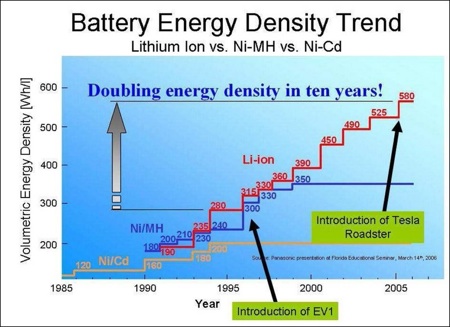
There's this:
"Air fueled battery has 10 times the energy density of current lithium ion batteries"
So we could have a small car with a range of 1000 miles. Surely acceptable.
Do you think we could maybe have a Hummer with a 150 mile range?
There's this:
"New Lithium Battery can store three times the energy of conventional lithium batteries"
http://www.sciencedaily.com/releases/2009/05/090518111731.htm
So a 450 mile range on a small cheap car or else a hummer with a 75 mile range?
Acceptable to anybody? I'd say yes.
And there's this:
"MIT Lithium Battery could recharge in seconds rather than hours"
Hmmm. If we combine a 450 mile range battery with recharging in seconds, can we say that's a perfect replacement for what we have now?
And last but not least there's this:
"Project Better Place will provide a network of battery swap stations that will allow owners of electric cars to have a depleted battery swapped for a fully charged one in a drive through station like a car-wash, all in less time than it takes to fill the gas tank of a conventional car"
http://www.betterplace.com/solution/charging/
So unlike the opinion of the dieoff crowd that technology won't save us. I'd have to disagree. Not only will technology save us, but it will be a pre-existing old technology that will save us: the humble battery.
For those with more interest in this topic,
please also visit peakoildebunked and ghawareguzzler as well as sciencedaily, newscientist and greencarcongress.
Subscribe to:
Posts (Atom)