So could we conceivably see Dieoff (capital D) from "peak water" i.e. the death of industrial civilization?
This one is interesting in a morbid kind of way because to a certain extent there is in fact already shortage of water.
Looked at one particular way, that is.
Interestingly, however, industrial civilization has not collapsed due to localized water shortages anywhere in the world so at the very beginning of the post we have to say, "no 'peak water' won't cause the dieoff of industrial civilization".
But let's continue, because we're just interested in general in knowing about water "shortages" and how they are solved.
If we ask the question: what water are we potentially short of and what are the solutions, it gets a lot more interesting.
Also: water is not like oil. It's not a non-renewable resource. Quite the contrary. There is such a thing as the water cycle. This is a problem of how to extract the maximum possible for the flow.
Anyways, lets ask some questions.
Are there water *shortages*? If so, what shortages are there? Lastly, how can we conceivably address these water shortages?
Are there water shortages?
Some people and industries would certainly say so, but I'd like to point out that the planet is covered in water. Only 28% of the planet is land therefore the other 72% is covered in water.
Since that water is seven miles deep in places we have a lot of water on the planet. An estimate of the mass of water might be somewhere around one and a half times ten to the 18 tonnes. In English that's something like 1.5 billion billion metric tonnes of water.
So what is the problem?
Well, for us land based creatures, we generally speaking need fresh water.
Of the gazzillion tonnes of water only 2 percent of that is fresh water of which three quarters is locked up in the polar caps. And if the caps melt, that water will join the rest of the salty water.
So we have an abundance of salt water and much less so of fresh water.
In fact, what we have is a distributed allocation of water. Some places are water rich and others are water poor. We have wet countries like Canada and Scotland and dry countries like Saudi Arabia. Parts of the USA are dry too such as the southwest.
Now, left to it's own devices without any human interference (i.e. let's sit round the campfire, sing kumbaya and let everything be taken care of by the "ecosystem") people who live in dry regions are short of fresh water.
How is that a problem?
If the dry region is *rich* it's not a problem. They have options such as importing bottled water, paying for a pipeline or aqueducts from a wetter region (such as the california aqueduct), building desalination plants (such as the wind turbine powered desalination plant in perth, western australia), buying their food from regions with water so they don't have to grow their food themselves et cetera et cetera
-Perth Desalination Plant-

There are endless ways to solve that particular problem if you have money.
What if you do not have money?
Well realistically we're talking about industrial civilization, whose main goal is to make money in the service of the economy. Those who are poor are of course the losers in the system and in any human system there are always unfortunately some losers.
In any case, what can be done?
Well many of the water "shortages" are in regions of the world with severely degraded soils due to overgrazing (such as by grazing the land with goats which notoriously eat almost everything and end up desertifying the land eventually). Additionally, many of the water "shortages" are in regions which are heavily overpopulated AND whose population mainly survive through erratic subsistence agriculture.
So... we essentially have 3 problems to overcome:
1. Desertification
2. Shortage of actual water supplies due to being in arid regions
3. Lack of industrial infrastructure leading to dependence on subsistence farming.
Sadly, there is not much to be done in poor regions if there are no funds since recovering land from the desert is expensive. It can be done but it's expensive and thus poor people can't do it.
Water shortages can be dealt with, on the other hand by conserving water and recycling it.
There are technical solutions to this such including water management whereby flash rains are stored rather than let evaporate away.
-Cheap Indian Water Storage System-
Additionally water can also be conserved by for example, instead of flushing it away into the ocean, wash your hands by dry alternatives or use chemical or hole-in-the-ground toilet facilities.
My main argument, however, would be to raise the living standards of the population so they could afford to trade and thus could take advantage of the available technology that could solve the problems.
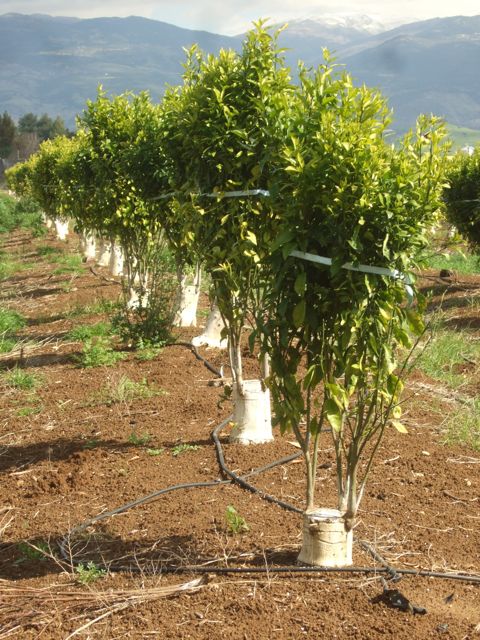
Failing that, if the people continue to depend on subsistence farming the soil as it is and the lack of fresh water as it is will inevitably lead to not enough food and water to go around for the overpopulation in arid areas. Israel is a good example of a mid-income nation who has been able to reclaim some of the land back from the desert and has excellent conservation practises to the extent that they export food due to for example, the Israeli invention of drip agriculture which is a super efficient irrigation method. But again, these are rich people solutions.
-Israeli Drip Irrigation-
What would be required to solve that particular problem without building e.g. aqueduct infrastructure or expensive desalination plants (not even the cheap ones such as glass buildings with guttering built over shallow lagoons) would be to develop drought resistant crops and salt water tolerant crops for those who live near to the coast and have access to ocean water. That way, trade could be kick-started and industrial development could take place at a rate great enough to enable the population to buy what they need from further afield if it's not available where they live.
Saltwater crops are very interesting because Seawater has 80% of the necessary crop nutrients in adequate concentrations for crop growing. Thus the need for fertilizer would be minimized if saltwater tolerant crops could be developed.
There has been some limited progress in developing saltwater tolerant crops. One particular example is a hybrid version of a galapagus island cherry tomato which can be grown in a 70% solution of seawater. It will take further work before these tomatoes could be grown in 100% seawater, but progress is being made.
One other idea that springs to mind is the use of drought tolerant biofuel crops such as agave that could be grown in desert regions with very little water, then traded for food crops grown in water rich regions.
A harder solution is the political one: in overpopulated regions, they should try to balance their population by trying to move towards 2 children per family instead of more. Luckily, even there progress is being made since as of 2010 there are only a handful remaining of the 180 some countries whose population growth is higher than 2 children per family. Projections are for the population to top out at 9.5 billion around 2040 and then gently decline in subsequent decades.
In short, rather than water shortages, what we have is an uneven distribution of wealth due to uneven distribution of resources. That is nothing to do with any putatitve peaks caused allegedly by any "limits to growth" and instead is a feature of human society. I do not propose to try to solve it or to make it worse, instead I will point out that uneven water distribution will not cause the end of civilization as we know it.