University of Minnesota researcher Janice Frias has cracked a key step closer to making renewable petroleum fuels using bacteria, sunlight and carbon dioxide.
Graduate student Janice Frias, who earned her doctorate in January, made the critical step by figuring out how to use a protein to transform fatty acids produced by the bacteria into ketones, which can be cracked to make hydrocarbon fuels.
Why this is different from other "biofuels" is that instead of generating biomass which is cooked into ethanol (along with the need to have vehicles that can run on ethanol), this process is a drop in replacement for standard diesel.
Ketones are especially useful because they can be dropped into standard catalytic cracking processes which generate standard diesel or other hydrocarbons as output. The inputs are only bacteria, sunlight and atmospheric carbon dioxide.
Given the political hot-potato of "climate change", there is significant interest in using carbon dioxide from the atmosphere to generate fuels. Using carbon dioxide as a source is a double win, because it's freely found in the atmosphere and removing it should be good for the environment.
The bacteria used in Synechococcus, which fixes carbon dioxide into sugars using sunlight as an input. These sugars are in turn passed as feedstock to another bacteria, Shewanella, which produces ketones as an output. The ketones are then cracked into hydrocarbons.
I don't know how scalable this is, but every little helps.
Showing posts with label biofuel. Show all posts
Showing posts with label biofuel. Show all posts
Tuesday, 29 March 2011

Monday, 29 November 2010
Oooops! Yet another substitute: this time Plastics.
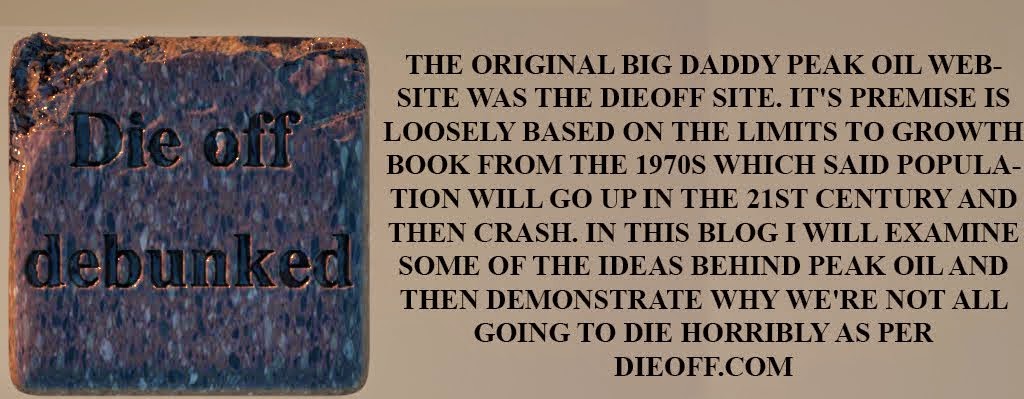
So according to dieoff.org the main reason we are about to dieoff is that global oil production is about to go into a precipitous and imminent decline and that since there are NO viable substitutes and every single product made out of oil is necessary to our very existence we are therefore doomed to a massive population crash.
I have diligently debunked this theory by means of pointing out that not only do we have substitutes but also that some of the products currently made by oil are not even necessary.
Here's yet another one:
Scientists at the University of Massachusetts have just come up with a zeolite catalyst that can be produced cost effectively leading to a process to create plastic feedstocks (such as bezene, toluene, xylene and olefins) from renewable biomass which is on par economically with current production methods using petroleum based feedstocks.
The new catalyst is an add-on drop-in piece of technology which can be used with no change in current infrastructure.
What's interesting about this is that it increases the net worth of existing cropland since currently low-value waste products can now be converted into high value chemical feedstock with an end-value higher even than fuel.
Given that we use about a million barrels a day in North America for chemical feedstocks this is great news.
I have diligently debunked this theory by means of pointing out that not only do we have substitutes but also that some of the products currently made by oil are not even necessary.
Here's yet another one:
Scientists at the University of Massachusetts have just come up with a zeolite catalyst that can be produced cost effectively leading to a process to create plastic feedstocks (such as bezene, toluene, xylene and olefins) from renewable biomass which is on par economically with current production methods using petroleum based feedstocks.
The new catalyst is an add-on drop-in piece of technology which can be used with no change in current infrastructure.
What's interesting about this is that it increases the net worth of existing cropland since currently low-value waste products can now be converted into high value chemical feedstock with an end-value higher even than fuel.
Given that we use about a million barrels a day in North America for chemical feedstocks this is great news.
Wednesday, 15 September 2010
Algal Oil Breaktrhoughs?
I noticed the following press release:
"Joule Unlimited, Inc., has been awarded a US patent covering its conversion of sunlight and waste carbon dioxide directly into liquid hydrocarbons that are fungible with conventional diesel fuel. Joule is the first to achieve and patent a direct, single-step, continuous process for the production of hydrocarbon fuels requiring no raw material feedstocks, enabling fossil fuel replacement at high efficiencies and costs as low as $30 per barrel equivalent."
So... good news, right?
Or is it?
Well anything that slows the decline rate of oil should be good news but I think a bit of careful analysis will show that there is a rusty nail in the silver lining.
Assuming this works then we are talking about a 10% efficiency rate for capture of the solar energy by these microorganisms. That's about 6X better than the best biofuel crops.
So what's the problem?
Well it's the same as the problem with regular oil: if we're going to find 2-4 new million barrels of oil energy equivalent every single year after peak oil it's going to be seriously difficult to do.
Why?
Simply because internal combustion vehicles are ridiculously inefficient because close to 90% of the energy from the raw crude oil product is wasted by the time it's processed into gasoline (or diesel), transported and then burned in the extremely inefficient (25%!) internal combustion engine.
So taking those numbers your microorganisms are really pumping out at a 2% efficiency rating.
Conversely, the worst efficiency solar panels are already operating at 10% efficiency and given that electric vehicles are closer to 90% efficient compared to 10-15% efficient for the internal combustion engine we are looking at 9% for the worst solar cells. The best on the market solar cells right now are 25% so that would mean we would get 22% of the energy back for electric cars.
Clearly for cars and trucks algal oil or biofuel is not the way to go.
But it's not a total downer, however, because there is one application that needs liquid fuels:
Jet travel.
Post-peak oil, there are substitutes for almost everything except jet travel.
You can move freight to electric trains instead of long distance big rigs (though we could convert long distance big rigs to nat gas). You could take trains for long distance passenger travel or else you could take your electric truck on a route which has project better place style battery swap stations along the way or else you could take a boat powered by nuke. But jet travel is difficult to do without liquid fuels.
In reality in the meantime we could create liquid fuels from coal or else natural gas and this has been done already but let's assume that our only option is biofuels. (And to be honest everything is welcome).
So let's look at what that might look like in some post peak world:
Right now (fall 2010) for my pathetic fuel mileage dodge durango (15 miles per gallon) if I want to take a trip, to say, disneyland it's about 2000 miles each way so a 4000 mile trip. That's 266 gallons. At $3 a gallon that's $798. Call it $800.
Now on the least expensive flight option (and let's say I get a FREE rental vehicle at the other end with gas include (bursts out laughing)) it's $400 per person. So for myself, my wife and two kids it'll run me $1600 to fly.
That's a decent difference, but people today will still pay for that to avoid the hassle of driving 4000 miles.
At an efficiency rating of 4X worse than electric means of transportation, you may expect to see flights cost 4x what it costs to drive, so my trip to disneyland would cost $3200 in today's money.
Expensive, but not out of reach for a two income family.
"Joule Unlimited, Inc., has been awarded a US patent covering its conversion of sunlight and waste carbon dioxide directly into liquid hydrocarbons that are fungible with conventional diesel fuel. Joule is the first to achieve and patent a direct, single-step, continuous process for the production of hydrocarbon fuels requiring no raw material feedstocks, enabling fossil fuel replacement at high efficiencies and costs as low as $30 per barrel equivalent."
So... good news, right?
Or is it?
Well anything that slows the decline rate of oil should be good news but I think a bit of careful analysis will show that there is a rusty nail in the silver lining.
Assuming this works then we are talking about a 10% efficiency rate for capture of the solar energy by these microorganisms. That's about 6X better than the best biofuel crops.
So what's the problem?
Well it's the same as the problem with regular oil: if we're going to find 2-4 new million barrels of oil energy equivalent every single year after peak oil it's going to be seriously difficult to do.
Why?
Simply because internal combustion vehicles are ridiculously inefficient because close to 90% of the energy from the raw crude oil product is wasted by the time it's processed into gasoline (or diesel), transported and then burned in the extremely inefficient (25%!) internal combustion engine.
So taking those numbers your microorganisms are really pumping out at a 2% efficiency rating.
Conversely, the worst efficiency solar panels are already operating at 10% efficiency and given that electric vehicles are closer to 90% efficient compared to 10-15% efficient for the internal combustion engine we are looking at 9% for the worst solar cells. The best on the market solar cells right now are 25% so that would mean we would get 22% of the energy back for electric cars.
Clearly for cars and trucks algal oil or biofuel is not the way to go.
But it's not a total downer, however, because there is one application that needs liquid fuels:
Jet travel.
Post-peak oil, there are substitutes for almost everything except jet travel.
You can move freight to electric trains instead of long distance big rigs (though we could convert long distance big rigs to nat gas). You could take trains for long distance passenger travel or else you could take your electric truck on a route which has project better place style battery swap stations along the way or else you could take a boat powered by nuke. But jet travel is difficult to do without liquid fuels.
In reality in the meantime we could create liquid fuels from coal or else natural gas and this has been done already but let's assume that our only option is biofuels. (And to be honest everything is welcome).
So let's look at what that might look like in some post peak world:
Right now (fall 2010) for my pathetic fuel mileage dodge durango (15 miles per gallon) if I want to take a trip, to say, disneyland it's about 2000 miles each way so a 4000 mile trip. That's 266 gallons. At $3 a gallon that's $798. Call it $800.
Now on the least expensive flight option (and let's say I get a FREE rental vehicle at the other end with gas include (bursts out laughing)) it's $400 per person. So for myself, my wife and two kids it'll run me $1600 to fly.
That's a decent difference, but people today will still pay for that to avoid the hassle of driving 4000 miles.
At an efficiency rating of 4X worse than electric means of transportation, you may expect to see flights cost 4x what it costs to drive, so my trip to disneyland would cost $3200 in today's money.
Expensive, but not out of reach for a two income family.
Subscribe to:
Comments (Atom)