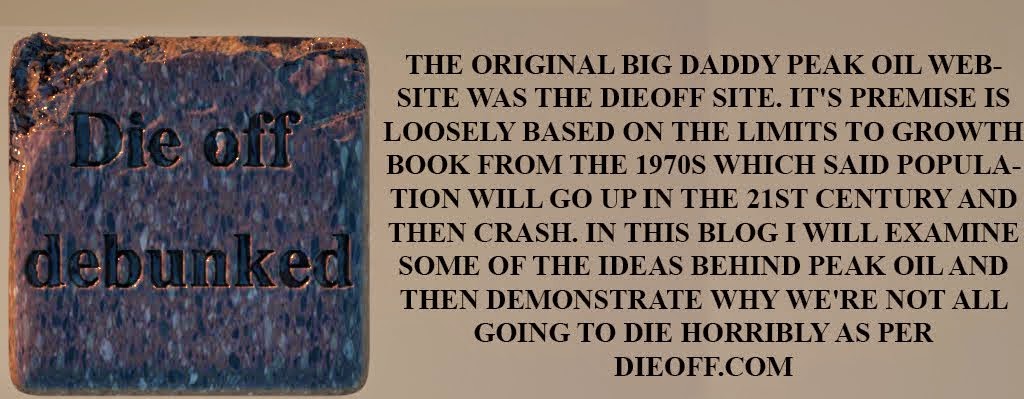
Meanwhile, down at the Gunchester....
To be continued...
Wednesday, 10 December 2014
Doom by low oil prices?
Oil prices continue their precipitous plunge into the abyss.
Unless, however, you believe economics is bogus (and most doomers do), you'd be inclined to think that this is a good thing.
I've heard various conspiracy theories that the collapse in prices is caused by various groups who want to stick it to various other groups.
One other possibility is this: Saudi et al, not only are not on the cusp of massive oil depletion at Ghawar etc but in fact see the writing on the wall. There is now a theoretical cap on oil prices. We can substitute transportation by fossil fuels to non-fossil fuels in a variety of use cases by a variety of methods. Everything from electric cars, trucks and trains to nuclear powered freighter ships. If we wanted to, we have the technical means to substitute away. So will we?
I happen to think that the situation we are in is this:
In a market based global economy (which more or less our little blue planet is, give or take a few definitions and basket-case states), generally the best priced items win. If oil prices remain high, the substitutes will chip away and chip away.
An electric car such as a volt (in which you do most of your driving using electricity) is basically a permanent stripping away (for at least the lifetime of the vehicle) of several barrels per unit of time of demand.
Now scale that up and imagine what it actually looks like for a large producer of oil: The oil price is set at the margin - the last few barrels of supply set the price for all the barrels. Right now demand is 96 some million barrels per day but supply is 98 million some barrels per day.
Now if we are to believe the more conservative economists, it isn't substitution that is causing this, it's a slowdown in China and Europe being in the doledrums that is causing a buyers market.
So why does Saudi not cut production?
Well you can believe the conspiracy theorists (e.g. they are trying to crush the Iranians/Venezuelans/Russians etc)
OR
Maybe the Saudis see the long term writing on the wall and they are trying to slow down the long term fall in price? i.e. to spell it out: Is Saudi scared of Tesla????
Now an interesting corrollary is this: I happen to love the idea of electric cars. But I don't want to pay $40-80K for one. The Tesla market shouldn't be much affected because, being a luxury market, it's price insensitive.
BUT.... the cheap end of the market (e.g. the Nissan Leafs and the Chevy Volts) ought to be a little more price sensitive. Will it be, or will they throw in the towel and let the Chinese eat their lunch when oil prices go back up in the next business cycle? Who knows, but interesting times.
Monday, 8 December 2014
Breakthrough grid storage tech?
Company to watch:
Applied Exergy Inc.
These guys are privately owned right now.
What they appear to have, however, is what looks like a breakthrough grid storage technology.
Basically they work with the concept of Exergy.
If I horribly bastardize the physics concept of Exergy what we're talking about is the amount of work potential available when a component of a thermodynamic system goes from one temperature to another.
How they appear to have harnessed this, is by taking energy from renewable sources such as wind, solar etc and attempting to store it in the form of slushy ice-water. So when power is abundant (i.e. when the wind is blowing or the sun is shining), much of that energy is stored.
Now the advantage of this system is basically comparative. If you look at the (massive) amount of stored energy just sitting there in fossil fuels, it's massive. The dirty (no pun intended) little secret of fossil fuels, however, is that though it's got somewhere on the order of 4x the energy density of our most prevalent technical storage solution (lithium-ion batteries), what we're missing is that by the time you get it out of the ground, process it, refine it, transport it and finally burn it inside of an internal combustion engine you only have about 18% of the stored energy actually available for useful work.
It's horribly inefficient.
Compare that, however, with batteries. Your electric motors are some 90% efficient and batteries return also on the order of 90% of their stored electricity out. So if you use an electric motor driven vehicle powered by batteries you get 90% of 90% of 90% which is 73%.
That's a whopping FOUR times more efficient than fossil fuel powered vehicles.
That also, by the way is the reason why fuel cells are a non-starter technology from an energy perspective. Splitting water into hydrogen and oxygen by electrolysis, collecting the hydrogen and then compressing it, then transporting it, then burning it in fuel cells takes you down to somewhere around 30% of the original energy.
Which is why I rag on fuel cells as not being competitive in almost all use-cases.
(Which is not to say there are no viable use cases for fuel cells, there *are* but mass transportation of personal vehicles is not one of them).
So.... that brings us to Applied Exergy's solution: The efficiency of their exergy based process is about 80% on returned energy. So 90% of 80% of 90% is 65%. Which is not too too far off what we get out of lithium ion batteries, if you were using it for electric transportation. Which is pretty decent in fact.
That said, obviously electric transportation itself is a horrible use-case because you'd have to transport the ice-water, store it etc etc so you would get nowhere near the energy efficiency back.
Where it shines, however, is in grid storage. We're talking about large format batteries than can stored megawatt hours (or greater at a time). Lithium Ion batteries can do this, but they cost a significant amount. Water on the other hand is pretty cheap. So these puppies make what I think is a very, very compelling case for a grid storage solution.
So... where are we on this one?
Well Applied Exergy is a private company and it looks like they might be a startup also. They're not listed on any stock market exchange and they may also never actually bring anything to market. But, and here's the but... If they *do* have what they say they have then this little company could be a game changer for renewable power. Definitely one to watch.
Thursday, 30 January 2014
Tesla Model S drives across the US from NYC to LA in 6 days. Not too shabby.
A 62 year old Model S owner drove from New York city to Los Angeles in his model S by using Tesla's network of supercharger stations, thus bringing us closer to the day when range anxiety even of the extreme "I want to drive coast to coast" kind will be forever banished.
There are still huge areas of the country that don't have superchargers in them but this is a huge win for electric vehicles in general. A standing ovation to Tesla for making this possible. Exciting times!
Tuesday, 3 September 2013
Mid Term Energy Independence?
So much as I'd prefer that we in North America switch over to electric driving it increasingly looks like that we don't need to do it in a hurry (the Europeans on the other hand need to do it last decade because they depend on the Russians and the Middle East for their Oil Supplies, neither of whom are their best buddies).
Occidental Petroleum and Pioneer Petroleum have trialed some test wells in the well known (but up till now considered unrecoverable reserves) massive permiam basin in West Texas called the wolfcamp.
What's interesting about the Wolfcamp is that it's similar to the bakken but is a strata ten times as deep. In fact there is so much oil in it recoverable using horizontal drilling technologies that it appears to be second in size to the world's biggest petroleum field (the Ghawar in Saudi Arabia).
Why that's interesting is that North America over the last decade has gone from declining production (and having to import more from potentially hostile regions (like it looks the the Europeans are going to have to do unless they switch aggressively to electric transportation) to increasing production. Given that in the last five years, petroleum demand in Nroth America in aggregate has declined and supply has gone up (and continues to do so) - currently at 16 million barrels per day compared to demand of 19 million barrels per day) - it's not outside the realm of possibility that North America is petroleum independent within the next five years.
No dieoff for us then.
Tuesday, 30 July 2013
Dieoff by Famine doomers just received another slap upside the head
One of the tenets of dieoff by peak oil is that (allegedly) oil = fertilizer and there are no alternatives (allegedly).
So let's run with the false assertion that there were no non-oil based alternatives to fertilizer up till now. Why is that? What does that mean?
Well the reason is this (or would be if it were 100% true): Most crops cannot obtain nitrogen fertilizer from the air though some can (notably legumes like peas). Those that can do not need nitrogen fertilizer or only a very little amount.
What are the consequences of this?
Well this means that we have to put artificial nitrogen fertilizer on our fields which leads to over-use which leads to nitrogen runoff which leads to fertilizer reaching the ocean which creates algae blooms which depletes oxygen which leads to fish dieoff in the ocean yadda yadda.
So it's a bit of a catch-22.
You need to put fertilizer on your crops to feed all the people but if you do it you poison the oceans which means people get less fish and the ecosphere has issues etc yadda yadda
And when the oil runs out (assuming that we see a peak and rapid decline) fertilizer will become too expensive and crop yields will decline and we can't get anything back from the ocean because the ocean is already contaminated. So we're fucked right?
Not really.
We can clean up the ocean by using targeted amounts (and thus less) fertilizer and thus limiting runoff. We also don't need to worry about oil going to fertilizer drying up because oil *isn't* the only source of nitrogen fertilizer. It's only (currently) the cheapest. Prior to the discovery of massive amounts of cheap oil, in the early industrial age, nitrogen fertilizer was mostly produced in Norway from hydro-electricity through a process which cracks the nitrogen out of the air and makes it into ammonia. So if need be we could go down that route again.
But....
The anti-apocaliptic horseman of science rides to the rescue once more.
Turns out that researchers at the University of Nottingham in the UK have discovered a way to make the bacteria which fix nitrogen from the air in legumes, useful for all sorts of crops.
One of the non-legume crops which has been colonized by nitrogen fixing bacteria is sugar cane in Brazil. After an extensive study of those bacteria species, the U of N researchers discovered one particular species which will readily colonize all sorts of crops.
The process is something like (I'm horribly paraphrasing here to come up with an analogy): make dried probiotic with the appropriate nitrogen fixing bacteria and coat the seeds of the corresponding crops with it. When the seeds sprout, the bacteria in the probiotic colonize the roots of the crops, thus enabling them to fix nitrogen from the air just like legumes can.
The upshot?
Doom from peak oil induced lack of nitrogen fertilizer has thus been postponed.
Thursday, 6 June 2013
New Battery Post: Lithium Sulphur with 4x energy density using cheaper materials than Li-Ion
Scientists at the Oak Ridge National Lab have recently cracked the elusive holy grail of Sulphur-Lithium batteries.
Sulphur is a very abundant element and thus even if the energy capacity were equal to or less than that of Lithium-Ion it would still be a breakthrough because it would make batteries cheaper and thus enable better the substitution away from fossil fuel powered vehicles.
But it isn't equal to Lithium-Ion. Li-Ion batteries have an energy density of about 170 Milliamp hours per gram. These new batteries have an energy density of 1200 milliamp hours per gram after 300 charge-discharge cycles.
This is significant. In a previous post I took the pessimistic case that with current generation electric vehicles the battery costs are such that driving one gives an equivalent cost of $6 per gallon for the most expensive electricity generated from all-renewables using very expensive vanadium flow batteries to store electricity off-peak. This is the most expensive possible scenario: a world in which everyone drives electric vehicles using current generation electric vehicles and all electricity production is from wind or solar. And the cost is equivalent to $6 a gallon today's money plus the cost of the vehicle meaning the average driver would pay $600-$800 per month in car loan plus aprrox $200 per month in electric "gas" for a total monthly driving cost of $800-$1000 per month.
These new batteries would mean that potentially the cost of electric "gas" would go down in an all-renewable world AND the cost of the monthly payments. If the cost breakdown of the batteries in an electric vehicle are the same as today ($10Gs for the vehicle and $20Gs for the batteries) then we would have $10Gs for the vehicle and $x for the batteries. Taking the cost of the materials as being the same but the range is 1200/170 = 7 times greater, let's do some math.
Now the current range of e.g. the leaf is 120 miles. That sucks. Let's bring it up. We want at least a range of 400 miles. So that's 400/120 = 3.33 times more battery. So we have 3.33/7 = 0.47 times the cost of the current batteries to give us 400 miles range instead of 120 miles range.
So at $20Gs for the initial price of the old-style battery, we have 0.47 x $20Gs = $9400 for the cost of the new and improved battery. Which gives us a price of $19,400 for the new and improved Nissan Leaf with a range of 400 miles. Not too shabby. This brings the price of the monthly car payment down from $600-$800 a month to $19,400/$30,000 = $388 to $517 per month for a total monthly driving cost of $588 to $717. That's *hardly* going to break the bank. And this is the *pessimisticly EXPENSIVE* case.
Now of course these batteries are still in the lab, but let's consider the implications in keeping with die-off debunked.
Well first of all clearly there's going to be no die-off at peak oil because we don't need oil for the largest part of current oil consumption (transportation). We can extrapolate further from there but that's for another post. Enough to mention that in this current world we have plenty of options for CHEAP electricity. We don't need to use expensive all-renewable electricity with batteries to store it. We could have a combination of cheap renewables, no batteries for storage, with off line backup utilizing nuclear, gas-powered, coal-powered, whatever. In other words I'm being way the hell too pessimistic in my calculations and likely what we're going to see is that cheap electric vehicles will start to chip away at the edges of any peak oil decline and we will HARDLY EVEN NOTICE it happening.
Now I say "chip away at the edges" rather than replace into insignificance because of one small inconvenient fact. North Americans i.e. the muppets of the global driving population will en-masse do something entirely stupid and counter-productive: Instead of choosing to drive e.g. Nissan Leafs with a 400 mile range costing $20Gs, they will instead prefer to drive F-150s or equivalent (whether fossil fuel powered or electric) due to their insistence on all the repeated myths they tell each other as to why the "NEED" large trucks for daily driving rather than "WANT". So North Americans will instead not take up electric vehicles at the same rate as other parts of the world because the largest market will be electric F-150s (or equivalent) with only a 120 mile range instead of nissan leafs (or equivalent) with a 400 mile range. Meaning that North America won't come into the electric game until the tail end of the switch-over. But never-mind - gas prices will probably not rise much higher than $6-$10 per gallon as a result of subsitution in the rest of the world.
The knock on effect of course will be that the rest of the world will be able to industrialize and buy automobiles because they will no longer be limited by the availability of cheap gasoline and instead will have the availability of cheap electricity with which to drive. And mobility creates markets.
So the conclusion is this: instead of seeing die-off because of peak oil or else "limits to growth" club-of-rome scenarios, we're going to see continued global growth and more of the global population lifted out of poverty. Business as usual in other words.
Die-off? Hit the snooze button.
Subscribe to:
Posts (Atom)