University of Minnesota researcher Janice Frias has cracked a key step closer to making renewable petroleum fuels using bacteria, sunlight and carbon dioxide.
Graduate student Janice Frias, who earned her doctorate in January, made the critical step by figuring out how to use a protein to transform fatty acids produced by the bacteria into ketones, which can be cracked to make hydrocarbon fuels.
Why this is different from other "biofuels" is that instead of generating biomass which is cooked into ethanol (along with the need to have vehicles that can run on ethanol), this process is a drop in replacement for standard diesel.
Ketones are especially useful because they can be dropped into standard catalytic cracking processes which generate standard diesel or other hydrocarbons as output. The inputs are only bacteria, sunlight and atmospheric carbon dioxide.
Given the political hot-potato of "climate change", there is significant interest in using carbon dioxide from the atmosphere to generate fuels. Using carbon dioxide as a source is a double win, because it's freely found in the atmosphere and removing it should be good for the environment.
The bacteria used in Synechococcus, which fixes carbon dioxide into sugars using sunlight as an input. These sugars are in turn passed as feedstock to another bacteria, Shewanella, which produces ketones as an output. The ketones are then cracked into hydrocarbons.
I don't know how scalable this is, but every little helps.
Tuesday, 29 March 2011

Tuesday, 8 March 2011
What Doomers believe according to Wikipedia Mar 08 2011
Some Anonymous doomers have attempted to taint the comments page (and in the process make this blog into a carbon copy of the other doomer peak oil cesspool blogs and forums). Additionally they have tried to muddy the waters by claiming that no doomer really believes in dieoff or collapse or indeed any of the other typical doomeresque crazy-as-a-loon beliefs held by our doomer friends.
Out of interest I decided to check the verifiable source of the truth: Wikipedia.
The results are pretty bleak: if wikipedia is correct and you're a doomer, it's time to hunker down in your basement awaiting the zombie hordes which will be created by a malthusian collapse of the population down past "carrying capacity" of the earths "depleted soil" which can "only be supported by oil-based-fertilizers."
Eeeeek!!!
As of March 8th 2011, The Wikipedia entry for doomers has the following to say:
"A convinced Doomer believes that the Green Revolution will collapse at the end of cheap oil.[1][dead link] According to Doomers, humanity will be in a state of overshoot after oil depletion makes modern farming methods economically unviable. Various academics have calculated that our numbers would then far exceed the carrying capacity of the earth. For example: they believe our situation is comparable to bacteria in a petri dish with cheap oil as the human growth medium. As the “growth medium” is consumed and runs out the “bacteria” dies off.
Doomers also hold a wide range of theories about the collapse of complex societies and systems.[2][dead link] The influences of Thomas Malthus and the Club of Rome are present in the doomer movement,[3][dead link][4][dead link][5] as are some of the more recent works by Joseph Tainter who wrote The Collapse of Complex Societies in 1988, and Richard C. Duncan who presented his Phd The Peak of World Oil Production and the Road to the Olduvai Gorge in 1989 (now known as the Olduvai theory.) The lectures and DVD by Albert Bartlett, Arithmetic, Population and Energy is also highly influential. (See below for online video streaming of the lecture he has been presenting and refining for over 30 years.)
The common concerns are that of overpopulation leading to resource and energy depletion, soil degradation and environmental destruction all culminating in agricultural collapse and famine. Some Doomers estimate that the anarchic collapse will be so catastrophic that population levels may fall below the levels prior to the industrial revolution — possibly below 2 billion. When trying to calculate the extent of the postulated dieoff, the most extreme doomer will also take into account that the existing eco-infrastructure is massively supported by oil based fertilizers and that we will not only hit peak oil but peak phosphate and peak nitrogen simultaneously. When oil production starts to decline the productivity of the soil will drop far below that of pre-industrial times and thus a drop down to 2 billion is optimistic. This kind of doomer will also ignore technology and dismiss it with commonly believed ideas such as "wind farms cost more energy to build than they get out". This common refrain is generally applied to all technology solutions since it is assumed a priori that a population crash is inevitable."
Thursday, 3 March 2011
Dieoff by Peak Water
So could we conceivably see Dieoff (capital D) from "peak water" i.e. the death of industrial civilization?
This one is interesting in a morbid kind of way because to a certain extent there is in fact already shortage of water.

Looked at one particular way, that is.
Interestingly, however, industrial civilization has not collapsed due to localized water shortages anywhere in the world so at the very beginning of the post we have to say, "no 'peak water' won't cause the dieoff of industrial civilization".
But let's continue, because we're just interested in general in knowing about water "shortages" and how they are solved.
If we ask the question: what water are we potentially short of and what are the solutions, it gets a lot more interesting.
Also: water is not like oil. It's not a non-renewable resource. Quite the contrary. There is such a thing as the water cycle. This is a problem of how to extract the maximum possible for the flow.

Anyways, lets ask some questions.
Are there water *shortages*? If so, what shortages are there? Lastly, how can we conceivably address these water shortages?
Are there water shortages?
Some people and industries would certainly say so, but I'd like to point out that the planet is covered in water. Only 28% of the planet is land therefore the other 72% is covered in water.

Since that water is seven miles deep in places we have a lot of water on the planet. An estimate of the mass of water might be somewhere around one and a half times ten to the 18 tonnes. In English that's something like 1.5 billion billion metric tonnes of water.
So what is the problem?
Well, for us land based creatures, we generally speaking need fresh water.
Of the gazzillion tonnes of water only 2 percent of that is fresh water of which three quarters is locked up in the polar caps. And if the caps melt, that water will join the rest of the salty water.
So we have an abundance of salt water and much less so of fresh water.
In fact, what we have is a distributed allocation of water. Some places are water rich and others are water poor. We have wet countries like Canada and Scotland and dry countries like Saudi Arabia. Parts of the USA are dry too such as the southwest.
Now, left to it's own devices without any human interference (i.e. let's sit round the campfire, sing kumbaya and let everything be taken care of by the "ecosystem") people who live in dry regions are short of fresh water.
How is that a problem?
If the dry region is *rich* it's not a problem. They have options such as importing bottled water, paying for a pipeline or aqueducts from a wetter region (such as the california aqueduct), building desalination plants (such as the wind turbine powered desalination plant in perth, western australia), buying their food from regions with water so they don't have to grow their food themselves et cetera et cetera
-Perth Desalination Plant-


This one is interesting in a morbid kind of way because to a certain extent there is in fact already shortage of water.
Looked at one particular way, that is.
Interestingly, however, industrial civilization has not collapsed due to localized water shortages anywhere in the world so at the very beginning of the post we have to say, "no 'peak water' won't cause the dieoff of industrial civilization".
But let's continue, because we're just interested in general in knowing about water "shortages" and how they are solved.
If we ask the question: what water are we potentially short of and what are the solutions, it gets a lot more interesting.
Also: water is not like oil. It's not a non-renewable resource. Quite the contrary. There is such a thing as the water cycle. This is a problem of how to extract the maximum possible for the flow.

Anyways, lets ask some questions.
Are there water *shortages*? If so, what shortages are there? Lastly, how can we conceivably address these water shortages?
Are there water shortages?
Some people and industries would certainly say so, but I'd like to point out that the planet is covered in water. Only 28% of the planet is land therefore the other 72% is covered in water.

Since that water is seven miles deep in places we have a lot of water on the planet. An estimate of the mass of water might be somewhere around one and a half times ten to the 18 tonnes. In English that's something like 1.5 billion billion metric tonnes of water.
So what is the problem?
Well, for us land based creatures, we generally speaking need fresh water.
Of the gazzillion tonnes of water only 2 percent of that is fresh water of which three quarters is locked up in the polar caps. And if the caps melt, that water will join the rest of the salty water.
So we have an abundance of salt water and much less so of fresh water.
In fact, what we have is a distributed allocation of water. Some places are water rich and others are water poor. We have wet countries like Canada and Scotland and dry countries like Saudi Arabia. Parts of the USA are dry too such as the southwest.
Now, left to it's own devices without any human interference (i.e. let's sit round the campfire, sing kumbaya and let everything be taken care of by the "ecosystem") people who live in dry regions are short of fresh water.
How is that a problem?
If the dry region is *rich* it's not a problem. They have options such as importing bottled water, paying for a pipeline or aqueducts from a wetter region (such as the california aqueduct), building desalination plants (such as the wind turbine powered desalination plant in perth, western australia), buying their food from regions with water so they don't have to grow their food themselves et cetera et cetera
-Perth Desalination Plant-


There are endless ways to solve that particular problem if you have money.
What if you do not have money?
Well realistically we're talking about industrial civilization, whose main goal is to make money in the service of the economy. Those who are poor are of course the losers in the system and in any human system there are always unfortunately some losers.
In any case, what can be done?
Well many of the water "shortages" are in regions of the world with severely degraded soils due to overgrazing (such as by grazing the land with goats which notoriously eat almost everything and end up desertifying the land eventually). Additionally, many of the water "shortages" are in regions which are heavily overpopulated AND whose population mainly survive through erratic subsistence agriculture.

So... we essentially have 3 problems to overcome:
1. Desertification
2. Shortage of actual water supplies due to being in arid regions
3. Lack of industrial infrastructure leading to dependence on subsistence farming.
Sadly, there is not much to be done in poor regions if there are no funds since recovering land from the desert is expensive. It can be done but it's expensive and thus poor people can't do it.
Water shortages can be dealt with, on the other hand by conserving water and recycling it.
There are technical solutions to this such including water management whereby flash rains are stored rather than let evaporate away.
-Cheap Indian Water Storage System-

Additionally water can also be conserved by for example, instead of flushing it away into the ocean, wash your hands by dry alternatives or use chemical or hole-in-the-ground toilet facilities.
My main argument, however, would be to raise the living standards of the population so they could afford to trade and thus could take advantage of the available technology that could solve the problems.
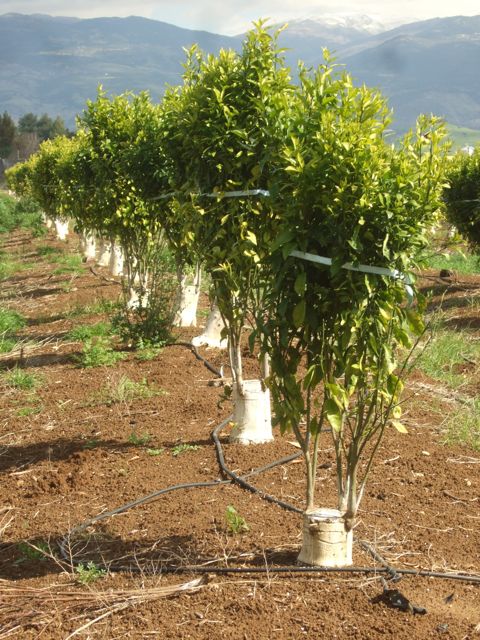
Failing that, if the people continue to depend on subsistence farming the soil as it is and the lack of fresh water as it is will inevitably lead to not enough food and water to go around for the overpopulation in arid areas. Israel is a good example of a mid-income nation who has been able to reclaim some of the land back from the desert and has excellent conservation practises to the extent that they export food due to for example, the Israeli invention of drip agriculture which is a super efficient irrigation method. But again, these are rich people solutions.
-Israeli Drip Irrigation-
What would be required to solve that particular problem without building e.g. aqueduct infrastructure or expensive desalination plants (not even the cheap ones such as glass buildings with guttering built over shallow lagoons) would be to develop drought resistant crops and salt water tolerant crops for those who live near to the coast and have access to ocean water. That way, trade could be kick-started and industrial development could take place at a rate great enough to enable the population to buy what they need from further afield if it's not available where they live.
Saltwater crops are very interesting because Seawater has 80% of the necessary crop nutrients in adequate concentrations for crop growing. Thus the need for fertilizer would be minimized if saltwater tolerant crops could be developed.
There has been some limited progress in developing saltwater tolerant crops. One particular example is a hybrid version of a galapagus island cherry tomato which can be grown in a 70% solution of seawater. It will take further work before these tomatoes could be grown in 100% seawater, but progress is being made.

One other idea that springs to mind is the use of drought tolerant biofuel crops such as agave that could be grown in desert regions with very little water, then traded for food crops grown in water rich regions.

A harder solution is the political one: in overpopulated regions, they should try to balance their population by trying to move towards 2 children per family instead of more. Luckily, even there progress is being made since as of 2010 there are only a handful remaining of the 180 some countries whose population growth is higher than 2 children per family. Projections are for the population to top out at 9.5 billion around 2040 and then gently decline in subsequent decades.

In short, rather than water shortages, what we have is an uneven distribution of wealth due to uneven distribution of resources. That is nothing to do with any putatitve peaks caused allegedly by any "limits to growth" and instead is a feature of human society. I do not propose to try to solve it or to make it worse, instead I will point out that uneven water distribution will not cause the end of civilization as we know it.
Thursday, 24 February 2011
How well does the Volt really work for saving gasoline?
Those of you who read this blog know I'm a big fan of electric cars to displace oil usage from the soon to be declining oil production.
Those who buy an electric car will be laughing all the way to the bank as the nay-saying F150 (and similar) will be whining about gas prices north of $5 a gallon.
So let's look at a real-world example of this:
Lyle Dennis, who lives in New York state and owns GM-Volt.com was given one of the first pre-production volts back in November last year. I'm going to report on how it went.
Lyle had the vehicle for 90 days and drove it 5100 miles. It has to be noted that this period was during the frigid weather we've been having so it was a fairly good winter test. (Though I'd like to see an equivalent test in the summer time in Arizona but let's not quibble).
Anyways, the results were he drove 5,100 miles and used 46 gallons of gasoline. It should be noted that his commute was greater than the all electric range of the volt so someone whose commute is less will be mostly all electric.
Now if we assume 36KW/h per 100 miles driven that gives us 36x51 = 1836 KW/h. The average price for electricity in the US varies between 10c/KW/h up to 20c/KW/h. Let's take the high end.
20 cents times 1836 gives us $367 plus $3 per gallon @ ($3x46=$138) gives us a total fuel cost of $505. Now it's somewhat less than that because I don't know how much extra he drove outside the electric range, but let's assume it was 10%. So that means the total cost was in the region of $470 for 5,100 miles at today's price of $3 per gallon.
If, instead, he had driven a diesel sub-compact such as a VW jetta, whose fuel efficiency is about 45 miles per gallon we would have 5,100 / 45 x $3 = $340.
So at $3 per gallon, it's still about 20% cheaper to drive a high efficiency diesel (assuming we can get fuel) using the HIGHEST prices in the country for electricity. (Note, however, that most of the country will be around 15c per KW/h meaning we have breakeven but let's continue to be unfair to the volt by using the highest possible cost for electricity).
If we drive a more regular small car at 30 miles per gallon, then at today's prices the cost is $510. So we're ahead of the average small vehicle with "good" gas mileage in the USA today at current prices, just not a high efficiency diesel like a VW Jetta.
Let's fast forward into a future of higher gas prices and instability of supply such as we are temporarily experiencing with libya et cetera.
At $4 a gallon 46 gallons cost 4x46 = $184 and we still pay $337 for electricity (since electricity prices are not affected by oil supplies or unrest in the mideast). That gives us a fuel cost for the volt of $521 for the 5,100 miles.
For the high efficiency vehicle we get 5,100/45 x $4 = $453. It's now 10% cheaper to drive a high efficiency diesel than it would cost for the most expensive electricity in the country, but all the rest would now be cheaper.
For the average small vehicle at only 30 mpg it's starting to mount up. It's now $680.
So let's look further ahead, at $5 a gallon. (Note that $5 a gallon is a sure thing by 2015 even without supply disruptions based on current trends).
The volt will cost 46x$5 = $230 plus $330 is $560. As you can see, even at $5 per gallon the cost has only gone up slightly for the volt because part of the fuel usage is shielded from price rises.
Now let's look at the Jetta again: $566. Now even the Jetta costs more (one of the most fuel efficient production vehicles of it's size in the world).
For the average small car it's a whopping $850 a month.
The F-150 driver at this point will be screaming, because he'll be paying nearly $1700 a month in gas for the same commute. Ouch!
In any event, the doomers will say "well I'm better off with a jetta (until gas prices hit $5 a gallon)".
My response is, that's 2-3 years away at best. Unless you plan to lease a new Jetta NOW and then get another one at the end of the lease AND you pay top dollar for electricity, you're better off getting a volt.
Not just that: the moral smugness of driving a vehicle powered by electricity produced by Americans instead of paying for a war to maintain oil supplies in foreign lands.
Wednesday, 23 February 2011
Electric Cars and the magic date of 2015
The Baker Institute for Public Policy put out a report indicating that by far the best bang for the buck in mediating any putative oil crisis would be the rapid and aggressive uptake of electric cars.
I tend to agree with that.
Noting that it is stated Obama policy to have a million electric cars on the road in the US by 2015, I have wondered if that may have been a little optimistic given the continued and persistent whining you hear from the big truck drivers who believe that electric cars are very expensive glorified golf carts which are unsafe etc etc and they just won't drive them.
Sounds like a baby throwing it's toys out of the stroller in a tantrum to my ears, but nevertheless, there is indeed some price resistance even with the generous rebates given by the federal government. The production numbers in terms of vehicles produced per year were also on the low side to my eyes, so I suspected that though there is seed production capacity currently under construction or already in operation by most of the major auto manufacturers I had felt it would be premature to ask "are we there yet?" and answer with a definitive yes.
Now, however, into the scene jumps China, the 800 lb gorilla in the room. They have just come out and made a statement that they want to manufacture 1 million vehicles per YEAR by 2015.
Now that is more like it. If we are seeing prices in current ranges with production capacities in the thousands of units then I suspect that we may see between a 30-50% drop in price for the batteries with current generation. That could mean that e.g. a volt could be sold for $25,000-$30,000 and a leaf could be sold for $15,000-$20,000.
Now THOSE are numbers the average joe can work with.
Good times.
Tuesday, 22 February 2011
New Biodiesel Process based on Photosynthesis
There has been a paper published in "Photosynthesis Research Magazine" which is a peer reviewed journal in which a spinoff from Harvard, Joule Research, outlines its process.
The claims are nothing short of extraordinary.
Allegedly, Joule has bio-engineered an organism which is capable of continuously excreting what amounts to bio-diesel without the need for energetically expensive pre-processing of biomass.
The result is allegedly 10X greater than predicted yields from algae or 50X greater than the best biomass crops of today.
If we assume an extremely skeptical eye (i.e. not believing in magic) and imagine that the process works but it's not 50X but more like 2X or even 1X then we could still conceivably have a lower cost process depending on the cost of the industrial plant required.
I suspect we would be looking at some kind of bioreactor so the costs could be anywhere from "more expensive" to "significant" and thus the at-the-pump cost would of course depend on yield.
Let's wait and see on this one.
Libyan Oil Exports Destination
This is a short post for now with just some regurgitation of facts and very little analysis.
What is the current gap between supply and demand in the world oil market?
About 4 million barrels per day.
What is the size of libyan oil exports?
About a million and a half barrels per day.
Where do Libyan Oil Exports go?
In 2009, Brazil took 3%, Italy took 32%, Germany took 14%, China took 10%, France took 10%, Spain took 9%, the US took 5%, Other European countries took 14% and Other Asian Countries took 14%.

What is the oil consumption of Europe?
About 14 million barrels per day. So the loss of Libyan oil is about 9-10% of the EU oil supply.
On a positive note we still have about 4 million barrels per day of excess capacity so we're not (yet) short and unlikely to be facing a "last light" scenario any time soon.
This, however, does underline the need to ramp up non-oil based alternatives.
Hopefully any price spike ($4 a gallon anyone?) will convince the F150 and Dodge Ram drivers that they may need to start thinking about e.g. a GM Volt for their daily commute
Any case, we're about to find out if the global economy really does collapse based on "high" oil prices. I suspect it won't because my theory is that high prices (notwithstanding oil shocks) are generally driven by a strong economy instead of the other way round.
Subscribe to:
Posts (Atom)